
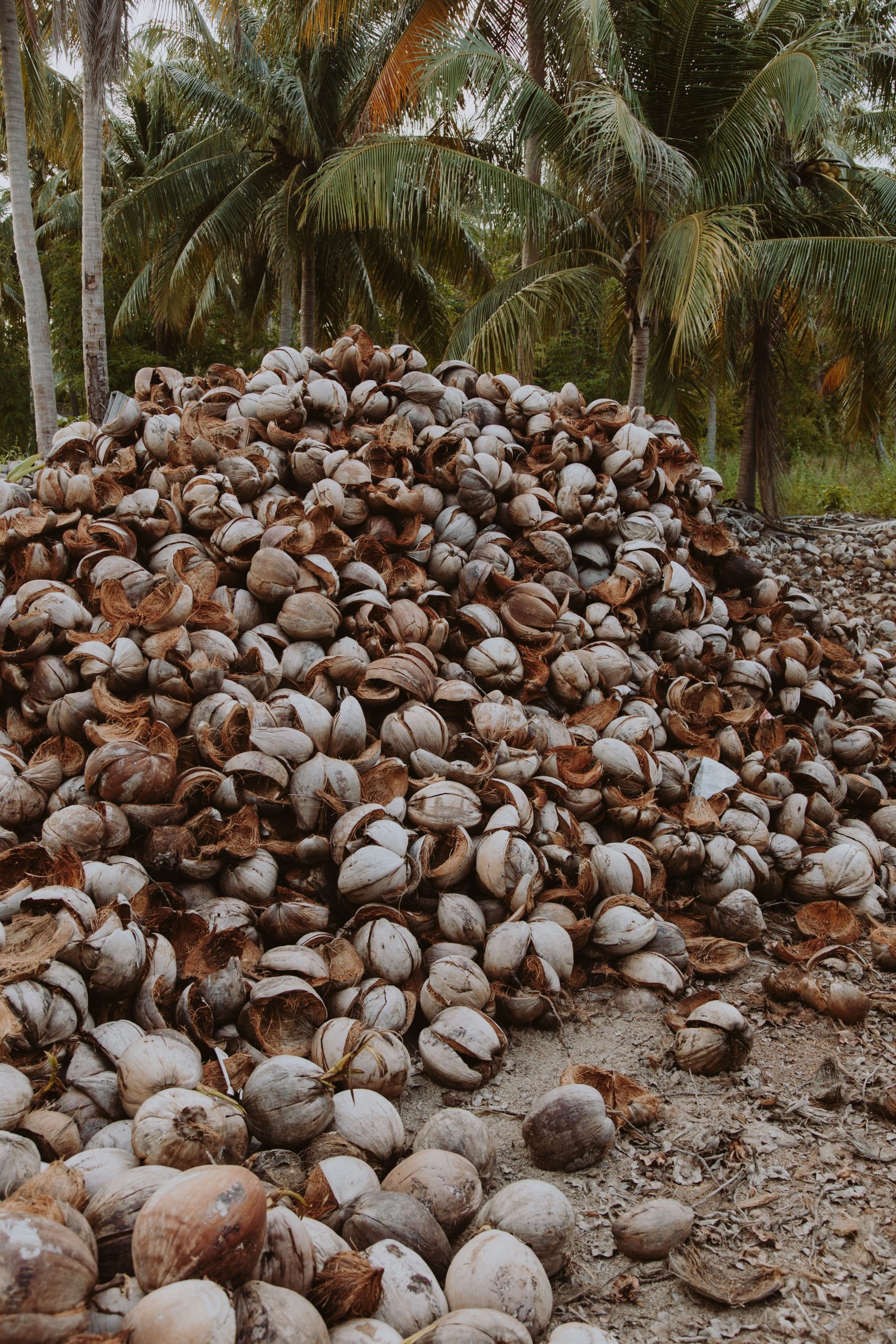
The empty fruit bunch (EFB, called raquis in Ecuador), the bunch left at the mill once the fruit is stripped, has four possible destinations: back to the field as mulch, compost, burning for heat, or pyrolysis to make biochar. Each one requires something. In a trial in Malaysia, EFB in the field released potassium quickly, but no nitrogen release was detected in 10 months. Composting it with the mill effluent depends, according to an industrial study, on parameters such as a roof, turning, and effluent and leachate management. To burn it, plan to dry it: according to a 2008 study, freshly sterilised bunches are typically around 60% water on a wet basis. And in a laboratory study, biochar from unwashed EFB had a lot of ash; with washed EFB, much less.
Contents
How much oil palm there is in Ecuador
In 2023, the Ministry of Agriculture and Livestock recorded oil palm production of 2,049,700 tonnes on 137,678 hectares, based on INEC data. Production is concentrated in two coastal provinces: Esmeraldas and Los Ríos.
We did not find an official source stating how much EFB comes from that production, so we do not give that figure. What counts for the decision is your own mill's volume.
Returning it to the field
It means taking the EFB back to the plantation and spreading it between the palms. In a field trial in Malaysia, with 37.5 and 75 tonnes per hectare under mature palms, the EFB lost half its dry matter in the first three months and 70% by eight months.
The same trial measured which nutrients it returned. Potassium was released very quickly: about 90% by six months. Nitrogen was not: no nitrogen release was detected during the 10 months of the study.
What to plan for: transport back to the plantation and labour to spread it.
Composting it
EFB can be composted together with the mill's liquid effluent. A study published in 2019 measured the process at an industrial mill in Central Kalimantan, Indonesia, on an unroofed concrete platform with about 3,000 mm of rain a year. In its composting trial (30 piles of 10 tonnes of EFB, 72 days, with 2017 data), moisture ended above 70%, and nutrient recovery ranged from 30% for potassium to 70% for phosphorus. The authors attribute this low recovery to the high ratio of effluent to EFB and to the rain, which washed away more than half of the nutrients originally present in the EFB and the effluent.
The authors identified seven critical practices: how much effluent comes out per tonne of fruit bunches, pretreatment of the effluent, how much effluent is added per tonne of EFB, whether the platform is roofed, how often the pile is turned, whether leachate is recycled, and how long the process lasts, including drying. In their conclusions, they single out platform roofing as a critical parameter that affects nutrient losses.
What to plan for, according to those practices: a platform, a roof, turning, and control of the effluent and the leachate.
Burning it for heat
EFB burns, but its moisture has to be planned for. According to a study published in 2008, freshly sterilised bunches are typically around 60% water on a wet basis. Once dried, that study's sample had a higher heating value of 19.35 MJ/kg, 5.36% ash and 2.00% potassium. The authors highlight the high ash and potassium values.
What to plan for: drying the EFB before burning it, and equipment designed for a fuel with ash and potassium. Before buying a burner, ask how it handles that fuel. Why ash decides which burner works is explained in our Spanish-language article El problema de la ceniza.
Pyrolysing it
In pyrolysis, EFB becomes biochar. In a laboratory study at 550 °C, unwashed EFB had 5.29% ash and its biochar ended up with 19.86% ash and 67.09% carbon. With EFB washed down to 1.60% ash, the biochar had 7.55% ash and 79.04% carbon.
Washing has its own figure: in the 2008 study, washing EFB with water removed more than 90% of the potassium and more than 80% of the ash from the feedstock tested, as a pretreatment for fast pyrolysis.
If you want the biochar certified under the European Biochar Certificate (EBC), the same rules apply as to any other, including: an H/Corg ratio below 0.7 in all its classes, and pyrolysis gases that are recovered or burned, not released into the atmosphere. The certificate class shows which use the biochar is admissible for. And if it is for farming in Ecuador, Agrocalidad requires registration to sell fertilisers, soil amendments and related agricultural products; check with Agrocalidad whether your product falls into that category. What to check before buying or selling biochar is covered in Biochar in Ecuador: what it is, what it is used for and how to tell whether it is good quality.
Questions before you decide
These questions apply to any equipment or service supplier, us included:
· How many tonnes of EFB come out each month, and at what moisture?
· What does my plantation need: potassium, nitrogen or organic matter? Do I have soil analyses?
· If I return it to the field: how much does it cost to transport and spread it?
· If I compost it: do I have a roofed platform, turning equipment and leachate management?
· If I burn it: how do I dry it first, and how does the equipment handle the ash and potassium?
· If I pyrolyse it: do I wash it first? What do I do with the wash water? What happens to the gases? Who buys the biochar, and for what use?
· Can you show me an analysis of my own EFB, not of EFB from the literature?
Frequently asked questions
Does EFB in the field replace fertiliser?
In the trial we cite, not entirely: EFB released about 90% of its potassium in six months, but no nitrogen release was detected in 10 months.
Can EFB be burned without drying it?
Plan to dry it: according to the 2008 study, freshly sterilised bunches are typically around 60% water on a wet basis.
How much ash did EFB biochar have in the study we cite?
In that laboratory study at 550 °C, unwashed EFB had 5.29% ash and its biochar 19.86%. With washed EFB, the biochar had 7.55%.
Which of the four options is best?
It depends on your operation: what your soil needs, whether you need heat at the mill and whether you want a product to sell. Get an analysis of your own EFB before deciding.
Conclusion
EFB does not have a single outlet. It has four, and each one asks for something: transport to the field, a well-managed composting platform, prior drying, or a pyrolysis plant (and, for less ash, prior washing). Start by measuring your EFB and deciding what you need from it.
Sources and methodology
Ecuador data:
· Ministerio de Agricultura y Ganadería (MAG), Estado del cultivo de palma aceitera en el Ecuador 2023, based on INEC-ESPAC 2023 data; figures updated to June 2024. PDF (accessed 26 Oct 2026)
Studies:
· Lim, K. C. and Zaharah, A. R. (2000). Decomposition and N & K release by oil palm empty fruit bunches applied under mature palms. Journal of Oil Palm Research 12(2): 55–62. Abstract (accessed 26 Oct 2026)· Baron, V., Saoud, M., Jupesta, J., Praptantyo, I. R., Admojo, H. T., Bessou, C. and Caliman, J.-P. (2019). Critical parameters in the life cycle inventory of palm oil mill residues composting. Indonesian Journal of Life Cycle Assessment and Sustainability 3(1): 24–41. Cirad record; full text read as PDF (accessed 26 Oct 2026)· Abdullah, N. and Gerhauser, H. (2008). Bio-oil derived from empty fruit bunches. Fuel 87: 2606–2613. PDF (accessed 26 Oct 2026)· Shariff, A., Mohamad Aziz, N. S. and Abdullah, N. (2014). Slow pyrolysis of oil palm empty fruit bunches for biochar production and characterisation. Journal of Physical Science 25(2): 97–112. PDF (accessed 26 Oct 2026)
Standards:
· European Biochar Certificate (EBC), v10.5E, 14 Aug 2025 — ch. 3, §7.2 and §8.3. PDF (accessed 21 Oct 2026)· Agrocalidad, Manual técnico para el registro y control de fertilizantes, enmiendas de suelo y productos afines de uso agrícola, edition 7 (approved 13 Jun 2022); current validity not confirmed — §5.1. PDF (accessed 21 Oct 2026)
Methodology: every figure comes from the original text of the source. The field and industrial studies are from Malaysia and Indonesia, and the biochar study is laboratory-scale; their figures are not predictions for an Ecuadorian mill. This article does not report data on Nina Energy's biochar or equipment.


