
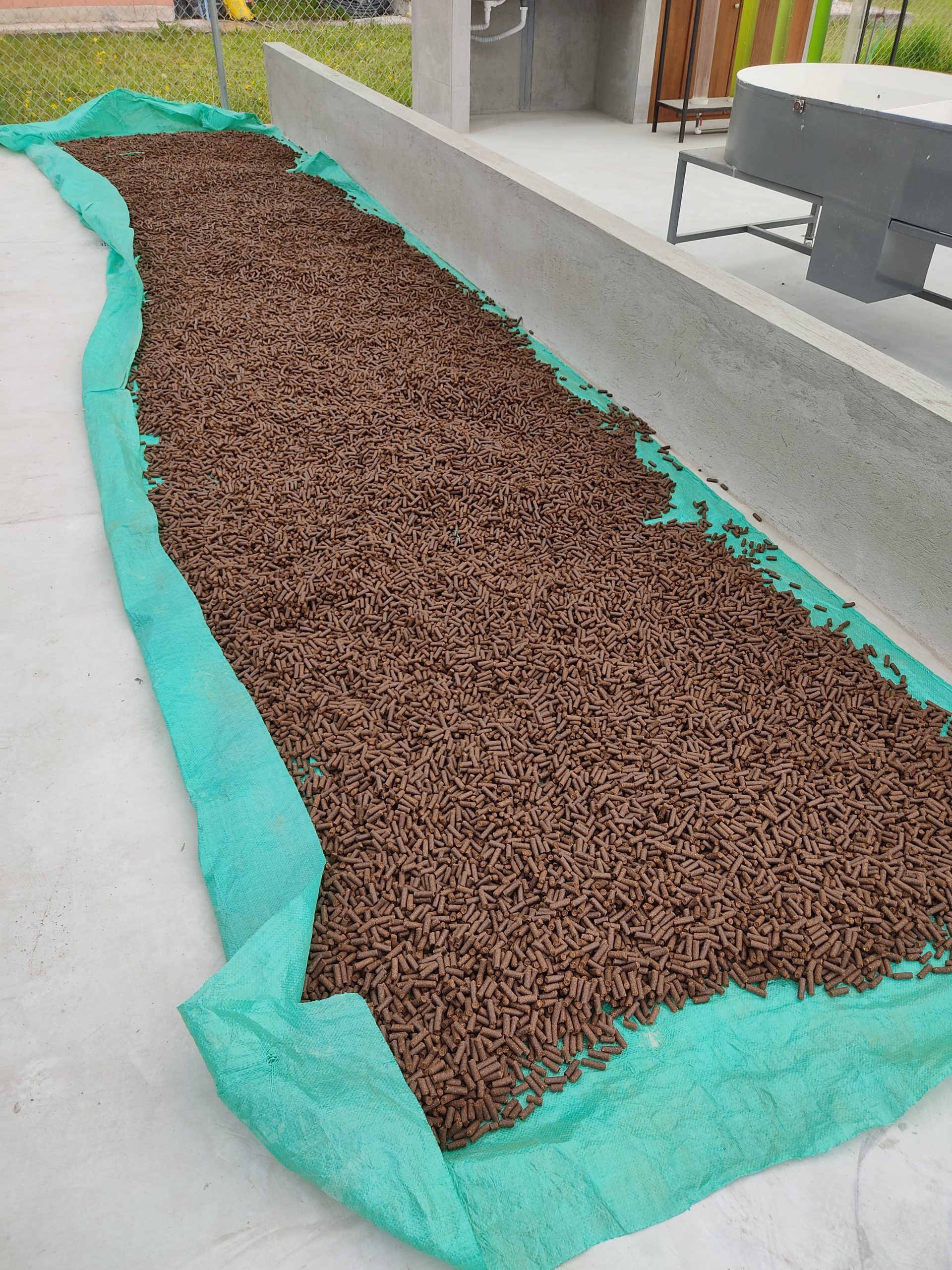
Before asking for the price of a pyrolysis plant, it pays to answer seven questions about the residue: what it is, what it carries besides biomass, how much water and ash it has, what shape it comes in, how much you generate and can prove, and what you want to get out of it. The answers help determine what equipment you need, what certification the biochar can have and whether the project can generate carbon credits.
Contents
The seven questions
1. What exactly is the residue?
"Agricultural residue" is not enough. The European Biochar Certificate (EBC) has a positive list of permitted biomasses, and each certification class has its own restrictions. If your residue is not on the list, its inclusion can be requested from Carbon Standards International, and the EBC's scientific committee decides. For carbon credits the question is similar: Puro.earth accepts forestry, agricultural, agro-industrial and palm residues, among others, but excludes food crops, and Isometric excludes biomass cultivated for the purpose of food, feed, energy or BiCRS.
2. Does it carry anything that is not biomass?
The EBC accepts only biomass, no fossil carbon. For soil or animal-feed uses, the biomass must not contain paint, solvents or toxic impurities, and plastic and rubber must not exceed 1% by mass. Wood with preservatives requires proof that pyrolysis eliminates them completely, and sewage sludge can only be certified in the EBC-Basic class. Painted pallets, mixed polypropylene sacks or treated wood change the answer.
3. How much water does it hold?
The EBC sets no moisture limit for the feedstock, but water costs energy: in a lab trial with eucalyptus, the wetter wood required more heat to decompose. That is why it matters who dries it, and with what. In our case, the reactor needs biomass at 10% moisture on entry, and we dry it with the reactor's own flue gases. If your residue comes out very wet, drying is part of the project, not a detail.
4. How much ash does it have?
Ash does not leave with pyrolysis: the mineral matter stays in the biochar. And more ash means less fixed carbon: in a study of five biomasses, poultry-litter biochar had about 30% carbon, while wood biochar reached about 90%. The EBC sets no minimum carbon content for a material to be called biochar: the organic carbon of biochar ranges from less than 20% to 95%.
5. What shape and size is it?
Our reactor is continuous, and feeding to the hopper is adapted to each site with belts, screw conveyors or bucket elevators. We torrefy palm empty fruit bunches in the dryer, mill them and pelletise them before pyrolysis. If your residue is fibrous, ask what pretreatment the offer includes.
6. How much do you generate, and can you prove it?
Seasonality matters as much as the average. And if you are thinking about carbon credits, the quantity has to be provable: Puro.earth requires all biomass sources to be declared with records of quantities, and Isometric requires the feedstock to be weighed per batch and evidence of what would have happened to the residue without the project, with a 5-year history or, in some cases, a sworn statement. If you do not weigh your residue today, start there.
7. What do you want to get out of it?
Heat for your process, biochar to sell or use, carbon credits, or a combination. The EBC requires pyrolysis gases to be recovered or burned, and at least 60% of the biomass energy to be put to useful form, for example as biochar, heat or electricity. In our reactor, the pyrolysis gas is recirculated to the thermal system. If a supplier cannot tell you what happens to the gas and the heat, part of the offer is missing.
Frequently asked questions
Is any agricultural residue suitable for certified biochar?
Not necessarily. It has to be on the EBC positive list, or approved by its scientific committee, and meet the limits of the class you are aiming for: no paint, solvents or toxic impurities for soil uses, and no more than 1% plastic and rubber (up to 10% in materials classes, with approval).
Do I need to dry the residue before pyrolysis?
It depends on the equipment. The EBC sets no moisture limit for the feedstock, but water costs energy. Our reactor needs 10% moisture on entry, and we dry with the reactor's own flue gases.
Can my residue generate carbon credits?
It depends on the methodology. Puro.earth accepts residues and excludes food crops; Isometric excludes biomass cultivated for food, feed, energy or BiCRS. Both require documentation: records of quantities and origin and, under Isometric, what would have happened to the residue without the project.
Conclusion
A pyrolysis quote is only as good as the residue data behind it. With the seven answers, a supplier can tell you what equipment you need, what pretreatment is required and what to expect from the biochar and the carbon. Without them, any price is a guess.
Sources and methodology
Standards and methodologies:
European Biochar Certificate (EBC), v10.5E, 14 Aug 2025: §4.1, §4.4, §4.5, §4.9, §8.3, §8.5 and ch. 2. PDF (accessed 13 Oct 2026)EBC, Positive list of permissible biomasses, 02_2025, 21 Oct 2025. PDF (accessed 13 Oct 2026)Puro.earth, Biochar Methodology, Edition 2025 v2, approved 27 Nov 2025, §3.4. PDF (accessed 13 Oct 2026)Isometric, Biomass Feedstock Accounting module v1.3, §3.1, §4.1 and Appendix 1. Registry (accessed 13 Oct 2026)
Studies:
Jesus et al. (2018). CERNE 24(3):288–294. doi:10.1590/01047760201824032561Tomczyk, Sokołowska & Boguta (2020). Reviews in Environmental Science and Bio/Technology 19:191–215. doi:10.1007/s11157-020-09523-3Domingues et al. (2017). PLOS ONE 12(5):e0176884. doi:10.1371/journal.pone.0176884
Methodology: every statement about standards and studies comes from the source's original text, accessed 13 October 2026. The data on our reactor (entry moisture, drying, feeding, empty-fruit-bunch pretreatment and use of the gas) are Nina Energy's own operating data. This article reports no yields or results for Nina Energy's biochar.


