
In the studies we read, the ash values reported for coconut shells and for plantain peels were very different. In a study from Taiwan, coconut shell had 0.45% ash on a dry basis, and when pyrolysed in the laboratory it gave from 57.63% biochar at 300 °C to 21.80% at 800 °C. By contrast, plantain peel collected in Portoviejo had 9.00% ash (the study does not say whether on a dry or wet basis). And in a study from Bangladesh, biochar made from banana peel at about 400 °C had 42.55% total potassium. These studies come from different countries, methods and materials, so they do not predict what your residue will contain: before choosing a destination, we recommend analysing its ash and potassium.
Plantain. According to the Ministry of Agriculture and Livestock, using data from INEC's agricultural survey, Ecuador produced 840,599 tonnes of plantain in 2023, on 119,637 harvested hectares. Manabí produced 307,447 tonnes (36.6%). The bulletin gives no figures for peels, and we did not find an official source stating how much peel comes from each tonne of plantain.
Coconut. We did not find a recent official figure for coconut production in Ecuador, so we do not give one. What counts for the decision is the volume that comes out of your plant, market or farm.
A study published in 2023 analysed two coconut residues in Portoviejo (Manabí): the fibre (the mesocarp) and the hard part (the endocarp). When they were calcined at 500 °C to 800 °C, potassium oxide made up 14.80% to 35.49% of the ash. That figure refers to the ash, not to the whole residue. The authors conclude that the fibre and endocarp could serve as raw materials for new composite materials.
On coconut shell, a 2024 study with coconut shell from Taiwan gave these values:
· Feedstock. 0.45% ash, 81.58% volatile matter and 17.97% fixed carbon, on a dry basis.
· Biochar. In a laboratory reactor (about 5 grams per run), the yield fell from 57.63% at 300 °C to 21.80% at 800 °C. The biochar made at 800 °C had the highest elemental carbon of the study's coconut shell biochars: 93%.
A study published in 2024 analysed plantain peel collected from markets, restaurants and snack producers in Portoviejo:
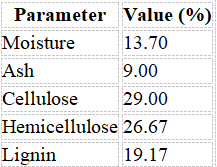
The study does not say whether the values are on a dry or wet basis, nor the plantain variety or ripeness. The 13.70% moisture does not necessarily describe fresh peel.
On biochar, we found a study from Bangladesh with banana peel, not plantain peel. It was pyrolysed for about 2 hours at about 400 °C, with little oxygen, in a container on a gas stove. The biochar had 42.55% total potassium. It is a single batch, at a single temperature, and the study does not report the yield.
What to do with the banana rachis (stalk) is covered in Banana rachis (stalk): what to do with it.
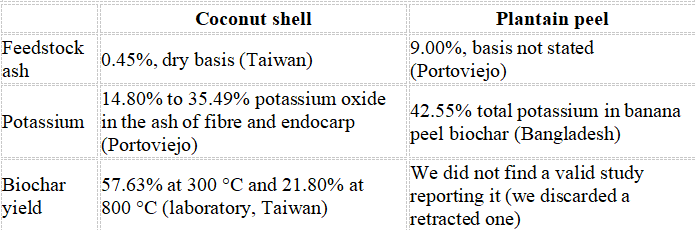
The figures come from different studies, with different methods and bases, so they cannot be compared directly. That is why we recommend measuring the ash and potassium of your residue before choosing a destination. Why ash decides which burner works is explained in our Spanish-language article El problema de la ceniza.
In pyrolysis, biomass becomes biochar; for coconut shell and banana peel we found the studies cited above, and for plantain peel we did not find one. According to the European Biochar Certificate (EBC), the organic carbon in biochar ranges from less than 20% to 95% of dry matter, depending on the feedstock. The analysis of the biochar from your residue is what will tell you where it falls.
If you want the biochar certified under the EBC, its rules include: an H/Corg ratio below 0.7 in all its classes, and pyrolysis gases that are recovered or burned, not released into the atmosphere. The certificate class shows which use the biochar is admissible for. And if it is for farming in Ecuador, the Agrocalidad manual (edition 7, from 2022; we could not confirm whether it is still in force) requires registration to sell fertilisers, soil amendments and related agricultural products; check with Agrocalidad whether your product falls into that category. What to check before buying or selling biochar is covered in Biochar in Ecuador: what it is, what it is used for and how to tell whether it is good quality.
These questions apply to any equipment or service supplier, us included:
· How many tonnes of peel or shell come out each month, and is it coconut (fibre, hard part or both) or plantain?
· At what moisture does it come out, and how long before it is used?
· Do I have an ash and potassium analysis of my residue?
· Does it come mixed with other waste (fruit remains, plastic, soil)?
· If I pyrolyse it: what yield and what carbon will the biochar have? What happens to the gases?
· Who buys the biochar, and for what use?
In the studies we read, the ash reported for coconut shells and for plantain peels was very different, and the potassium data measure different things (in coconut ash and in banana peel biochar), so they cannot be compared. Before deciding, we recommend analysing the ash and potassium of your residue, and knowing who will buy the biochar and for what use.
Ecuador data:
· Ministerio de Agricultura y Ganadería, Estado del cultivo de plátano en el Ecuador 2023 (figures updated to June 2024; source: INEC, ESPAC 2023). PDF (accessed 17 Nov 2026)· Vera Bravo, J. A., Zambrano Zambrano, R. A., Ponce, W., Córdova Mosquera, A. and Riera, M. A. (2024). Residuos de yuca y plátano como fuente de azúcares fermentables. Revista Ciencia en Desarrollo 15(1): 205–211, Table 2. doi:10.19053/01217488.v15.n1.2024.15495. PDF (accessed 17 Nov 2026)· San Andrés, G., Aguilar-Sierra, S. and Bernardo, G. (2023). Morphological, physical, and chemical characterization of coconut residues in Ecuador. Heliyon 9: e19267, Table 3. doi:10.1016/j.heliyon.2023.e19267. PDF (accessed 17 Nov 2026)
Studies from other countries:
· Jiang, T.-J., Morgan, H. M. Jr. and Tsai, W.-T. (2024). Optimization of Vertical Fixed-Bed Pyrolysis for Enhanced Biochar Production from Diverse Agricultural Residues. Materials 17(12): 3030. doi:10.3390/ma17123030. Article (accessed 17 Nov 2026)· Islam, M., Halder, M., Siddique, M. A. B., Razir, S. A. A., Sikder, S. and Joardar, J. C. (2019). Banana peel biochar as alternative source of potassium for plant productivity and sustainable agriculture. International Journal of Recycling of Organic Waste in Agriculture 8 (Suppl. 1): 407–413, Table 2. doi:10.1007/s40093-019-00313-8. Article (accessed 17 Nov 2026)
Standards:
· European Biochar Certificate (EBC), v10.5E, 14 Aug 2025 — ch. 3, §7.1, §7.2 and §8.3. PDF (accessed 21 Oct 2026)· Agrocalidad, Manual técnico para el registro y control de fertilizantes, enmiendas de suelo y productos afines de uso agrícola, edition 7 (approved 13 Jun 2022); current validity not confirmed — §5.1. PDF (accessed 21 Oct 2026)
Methodology: every figure comes from the original text of the source. The biochar studies are laboratory-scale or single-batch, and from other countries; their figures are not predictions for your residue. We discarded a study on banana peel biochar because it was retracted. This article does not report data on Nina Energy's biochar or equipment.