
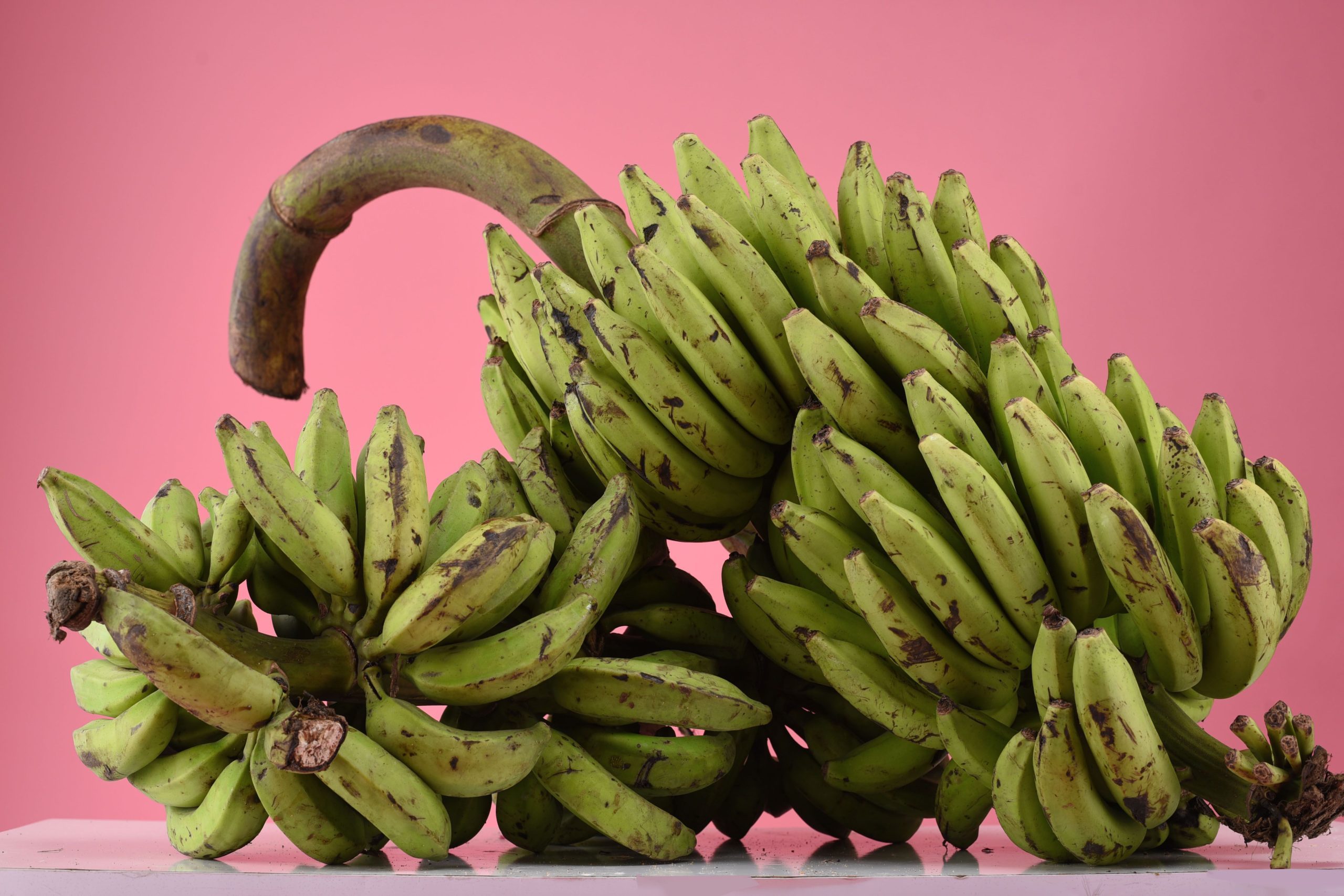
The rachis (also called pinzote) is the stalk of the banana bunch, one of the remnants of the packing process. It has four possible destinations: back to the field, compost, burning for heat, or pyrolysis to make biochar. In our view, what weighs most in the decision is its ash. In samples of Cavendish banana from Ecuador, the rachis had 26.6% ash (basis not stated), and in another study, with three varieties, between 29% and 30% of dry matter, with a lot of potassium among its soluble minerals. Partly because of that ash, the study on Ecuador left it out of its electricity calculation for El Oro, and the other identifies it as the main drawback for volatile yields in pyrolysis. In a three-year trial in Costa Rica, on a high-fertility soil and presented as a congress abstract, returning chopped pinzote to the field together with rejected fruit was associated with heavier bunches.
Contents
How much banana there is in Ecuador
In 2023, the Ministry of Agriculture and Livestock recorded 7,159,816 tonnes of banana (fresh fruit) on 175,181 hectares, based on INEC data. The provinces with the most production were Los Ríos, Guayas and El Oro.
We did not find an official source stating how much rachis comes from that production, nor a figure for rachis per box that we could verify, so we do not give those figures. What counts for the decision is your own packing plant's volume.
What the rachis contains
The rachis is generated in the post-harvest stage: it is one of the remnants of the packing process. In our view, what weighs most when deciding what to do with it is its ash:
· In Ecuador. In samples of Cavendish banana rachis, a study published in 2015 measured 26.6% ash and a lower heating value of 10.0 MJ/kg. The article does not say whether those values are on a dry or wet basis.
· In Cameroon. In rachis from three banana varieties, another 2015 study measured between 29.04% and 30.16% ash in dry matter. In that ash, potassium was between 40.9% and 43.5% of the soluble minerals.
Returning it to the field
This means chopping the rachis and spreading it between the rows. A three-year trial in Costa Rica, presented at an agronomy congress in 2006, tested it this way: fresh packing remnants (rejected banana and pinzote), chopped, were applied between rows in 5 cm layers every 8 weeks. They were compared with an area with no remnants.
The average bunch weight was 31.0 kg without remnants and 34.3 kg with remnants, a difference the authors report as significant. Two conditions: the trial mixed pinzote and rejected fruit, and it was carried out on a high-fertility soil for banana.
What to plan for: chopping it, transporting it from the packing plant to the rows, and the labour to spread it at regular intervals.
Composting it
We did not find a study of composting banana rachis on its own with figures we could verify. The ones we reviewed mix the rachis with other residues, or do not say which part of the plant they used. That is why we give no figures on composting times or compost nutrients for rachis.
If you are going to compost it, ask the supplier or the technician for data from a trial with your own rachis.
Burning it for heat
The rachis has a heating value, but its ash is a problem for burning it. The 2015 study on Ecuador calculated how much electricity could be generated from banana residues in El Oro and left out the rachis because of its high ash content and because it is generated in the post-harvest stage. The lower heating value it reports for the rachis is 10.0 MJ/kg. The Cameroon study notes that high ash can cause fouling and corrosion.
Why ash decides which burner works is explained in our Spanish-language article El problema de la ceniza. Before buying a burner for rachis, ask the supplier to show you how it performed with this residue.
Pyrolysing it
In pyrolysis, the rachis becomes biochar, and here too the ash counts. The Cameroon study concludes that ash was the main drawback for volatile yields in pyrolysis. We did not find a study of rachis biochar with carbon and ash data we could verify. According to the European Biochar Certificate (EBC), the organic carbon in biochar ranges from less than 20% to 95% of dry matter, depending on the feedstock. That is why the analysis of the biochar from your rachis is what will tell you where it falls.
If you want the biochar certified under the EBC, the same rules apply as to any other, including: an H/Corg ratio below 0.7 in all its classes, and pyrolysis gases that are recovered or burned, not released into the atmosphere. The certificate class shows which use the biochar is admissible for. And if it is for farming in Ecuador, Agrocalidad requires registration to sell fertilisers, soil amendments and related agricultural products; check with Agrocalidad whether your product falls into that category. What to check before buying or selling biochar is covered in Biochar in Ecuador: what it is, what it is used for and how to tell whether it is good quality.
Questions before you decide
These questions apply to any equipment or service supplier, us included:
· How many tonnes of rachis come out of my packing plant each month, and at what moisture?
· Do I have an ash and potassium analysis of my rachis?
· If I return it to the field: how much does it cost to chop, carry and spread it?
· If I compost it: is there a trial with my rachis, with times and compost analyses?
· If I burn it: has the equipment already run on banana rachis? How does it handle the ash?
· If I pyrolyse it: what carbon and what ash will the biochar from my rachis have? What happens to the gases? Who buys the biochar, and for what use?
· Can you show me an analysis of my own rachis, not one from the literature?
Frequently asked questions
What is pinzote?
It is the rachis: the stalk of the banana bunch, which is left as a remnant of the packing process.
How much ash does banana rachis have?
In the studies we cite, 26.6% in samples of Cavendish banana from Ecuador (the article does not state the basis), and between 29% and 30% of dry matter in three banana varieties in Cameroon.
Can the rachis be burned?
It has a heating value, but its ash is a problem. A study on Ecuador left it out of its electricity calculation for El Oro, among other reasons, because of its high ash content.
Is it worth returning it to the field?
In a three-year trial in Costa Rica, applying chopped pinzote together with rejected fruit between rows was associated with bunches of 34.3 kg compared with 31.0 kg without application. It is one trial, on a high-fertility soil and presented as a congress abstract, and it does not guarantee the same result on your farm.
Conclusion
In the studies we cite, banana rachis had a lot of ash, and that ash is a problem for burning it and also counts in pyrolysis. Before deciding, we recommend measuring your rachis: how much comes out, at what moisture, and how much ash and potassium it contains.
Sources and methodology
Ecuador data:
· Ministerio de Agricultura y Ganadería (MAG), Estado del cultivo de banano en el Ecuador 2023, based on INEC-ESPAC 2023 data; figures updated to June 2024. PDF (accessed 5 Nov 2026)
Studies:
· Guerrero, A. B., Aguado, P. L., Sánchez, J. and Curt, M. D. (2015). GIS-Based Assessment of Banana Residual Biomass Potential for Ethanol Production and Power Generation: A Case Study. Waste and Biomass Valorization. doi:10.1007/s12649-015-9455-3. PDF (accessed 5 Nov 2026)· Tiappi Deumaga, M. F., Happi Emaga, T., Tchokouassom, R., Vanderghem, C., Aguedo, M., Gillet, S., Jacquet, N., Danthine, S., Magali, D. and Richel, A. (2015). Genotype contribution to the chemical composition of banana rachis and implications for thermo/biochemical conversion. Biomass Conversion and Biorefinery. doi:10.1007/s13399-015-0158-6. PDF (accessed 5 Nov 2026)· Segura, R., Serrano, E. and Sandoval, J. (2006). Efecto de la aplicación de remanentes picados frescos del proceso de empaque del banano sobre las condiciones químicas y microbiológicas del suelo y la productividad del cultivo de banano. Memoria XII Congreso Nacional Agronómico y de Recursos Naturales, Colegio de Ingenieros Agrónomos de Costa Rica, p. 66. Congress abstract. PDF (accessed 5 Nov 2026)
Standards:
· European Biochar Certificate (EBC), v10.5E, 14 Aug 2025 — ch. 3, §7.1, §7.2 and §8.3. PDF (accessed 21 Oct 2026)· Agrocalidad, Manual técnico para el registro y control de fertilizantes, enmiendas de suelo y productos afines de uso agrícola, edition 7 (approved 13 Jun 2022); current validity not confirmed — §5.1. PDF (accessed 21 Oct 2026)
Methodology: every figure comes from the original text of the source. The studies are from Ecuador (samples with no province given, and a case study in El Oro), Cameroon and Costa Rica; their figures are not predictions for your packing plant. The Costa Rica trial is a congress abstract. This article does not report data on Nina Energy's biochar or equipment.