
The sawdust, shavings and chips that come out of sawmills and board factories can be used in three ways we review here: making pellets, burning them in a boiler or pyrolysing them to make biochar. In samples from a sawmill in Tumbaco, ash was low in pine and eucalyptus (0.32% and 0.37%) and higher in colorado and laurel (1.21% and 1.54%). That matters for pellets: the ENplus certification handbook (version 3.0, from 2015; we could not confirm whether it is still in force) requires 0.7% ash or less on a dry basis for class A1, and chemically untreated wood. The study does not say on what basis it measured ash, so your own sawdust has to be analysed. For burning, moisture counts, and according to a US Environmental Protection Agency reference it can range from 5% to 75% depending on the residue and storage. And for biochar, according to the European Biochar Certificate (EBC), wood biochar usually has 70% to 90% organic carbon in dry matter. Before anything else, a warning: wood dust is carcinogenic to humans, according to the International Agency for Research on Cancer.
In Ecuador, wood residues come mainly from industry: sawmills, particleboard and MDF factories, and chipping operations. They come out as sawdust, shavings and chips, according to a study published in 2016 by the Universidad Politécnica Salesiana.
We did not find an official source stating how many tonnes of sawdust or wood residues are produced each year in Ecuador, so we do not give that figure. What counts for the decision is the volume of your own sawmill or workshop.
The same study analysed residues from four species taken at a sawmill in Tumbaco (Pichincha):
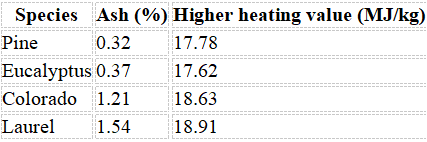
Values rounded to two decimals, here and throughout the article (our calculation).
The moisture of those samples ranged from 7% to 10%. The article does not say whether the ash is on a dry or wet basis, and the samples come from a single sawmill. Even so, at that sawmill the ash differed between species.
If you want to sell certified pellets, one of the certifications is ENplus. According to its handbook (version 3.0, from 2015), these are some of its requirements:
· Raw material (class A1). Stem wood, or chemically untreated wood by-products and residues.
· Ash. 0.7% or less in class A1, and 1.2% or less in A2, on a dry basis.
· Moisture. 10% or less.
· Mechanical durability. 98.0% or more in A1, and 97.5% or more in A2.
In the Tumbaco samples, pine and eucalyptus had less than 0.7% ash, and colorado and laurel more than 1.2%. Since the study does not state the basis of its ash, this is only a reference: to know whether your sawdust works for A1 pellets, it has to be analysed. We could not confirm whether version 3.0 of the handbook is still in force.
What to plan for: that your sawdust is not chemically treated, that its final moisture meets the limit, and a pellet mill.
Sawdust, shavings, chips and sanderdust are burned in boilers, according to the section of the US Environmental Protection Agency's AP-42 on wood residue combustion (2001). That document gives these reference values:
· Moisture. In the pulp, paper and lumber industries, wood is typically fired at close to 50% moisture. But it can range from 5% to 75% depending on the residue type and storage; furniture residue is usually 10% to 15%.
· Emissions. The main emission from wood boilers is particulate matter. And large variations in moisture can cause short-term emissions to fluctuate.
In Ecuador, the Universidad Politécnica Salesiana study calculated, for the design of a steam boiler, that about 12.45 kg per hour of pine residues would replace 5 gallons of diesel per hour. It is a design calculation, not a measurement in operation. What drying with biomass costs compared with diesel is covered in our Spanish-language article Secar cacao y café con biomasa en vez de diésel.
What to plan for: stable sawdust moisture, and particulate matter control.
In pyrolysis, sawdust becomes biochar. According to the European Biochar Certificate (EBC), the organic carbon in biochar ranges from less than 20% to 95% of dry matter depending on the feedstock, and in wood biochar it is usually between 70% and 90%.
If you want the biochar certified under the EBC, its rules include: an H/Corg ratio below 0.7 in all its classes, and pyrolysis gases that are recovered or burned, not released into the atmosphere. The certificate class shows which use the biochar is admissible for. And if it is for farming in Ecuador, the Agrocalidad manual (edition 7, from 2022; we could not confirm whether it is still in force) requires registration to sell fertilisers, soil amendments and related agricultural products; check with Agrocalidad whether your product falls into that category. What to check before buying or selling biochar is covered in Biochar in Ecuador: what it is, what it is used for and how to tell whether it is good quality.
The International Agency for Research on Cancer (IARC) classifies wood dust as carcinogenic to humans (Group 1). According to its monograph, it causes cancer of the nasal cavity and paranasal sinuses, and of the nasopharynx.
Whatever destination you choose, we recommend treating dust handling (collection, closed storage and respiratory protection) as part of the project, and checking the occupational safety rules that apply to your plant.
These questions apply to any equipment or service supplier, us included:
· How many tonnes of sawdust, shavings and chips come out each month, and from which species?
· Does my wood have any chemical treatment, paint or glue?
· Do I have an ash and moisture analysis of my sawdust?
· If I make pellets: does it meet the ash and moisture of the class I want to sell?
· If I burn it: how does the boiler handle changes in moisture and particulate matter?
· If I pyrolyse it: what carbon will the biochar have? What happens to the gases? Who buys the biochar, and for what use?
· How will I collect and store the dust to protect my people?
Sawdust can be used for pellets, in a boiler or to make biochar. For ENplus A1 pellets, the ash, the moisture and whether the wood is chemically untreated matter; for the boiler, moisture and particulate matter; for biochar, its analysis and what the intended use requires. Before deciding, we recommend analysing your sawdust and planning how you will handle the dust.
Study in Ecuador:
Arroyo, J. and Reina, W. (2016). Aprovechamiento del recurso biomasa a partir de los desechos de madera para una caldera de vapor. Ingenius 16: 20–29. doi:10.17163/ings.n16.2016.03. Article (accessed 12 Nov 2026)
Technical references:
U.S. Environmental Protection Agency (2001). AP-42, §1.6: Wood Residue Combustion in Boilers. PDF (accessed 12 Nov 2026)ENplus, ENplus-Handbuch Teil 3 (ENplus Handbook, Part 3: Pellet Quality Requirements), version 3.0 (August 2015), Tables 1 and 2. PDF; and ENplus G 1:2018, Table 1. PDF (accessed 12 Nov 2026). Current validity of version 3.0 not confirmed.International Agency for Research on Cancer (2012). IARC Monographs vol. 100C: Arsenic, Metals, Fibres, and Dusts, p. 459. PDF (accessed 12 Nov 2026)
Standards:
European Biochar Certificate (EBC), v10.5E, 14 Aug 2025 — ch. 3, §7.1, §7.2 and §8.3. PDF (accessed 21 Oct 2026)Agrocalidad, Manual técnico para el registro y control de fertilizantes, enmiendas de suelo y productos afines de uso agrícola, edition 7 (approved 13 Jun 2022); current validity not confirmed — §5.1. PDF (accessed 21 Oct 2026)
Methodology: every figure comes from the original text of the source, except the roundings marked as our calculation. The Ecuador study analysed samples from a single sawmill; its figures are not predictions for your sawdust. This article does not report data on Nina Energy's biochar or equipment.