Sugarcane bagasse already has a use in Ecuador. In 2023, 1,484 thousand tonnes were produced, and the National Energy Balance divides its use between industry, power plants and distilleries. According to a US Environmental Protection Agency reference, sugar mills burn it in boilers; the same reference says most bagasse is burned at 45% to 55% moisture and that its main pollutant is particulate matter. Pyrolysing it yields biochar: in a laboratory study in Brazil, the yield was 33% at 400 °C and 25% at 600 °C. The ash in the biochar varied widely between the studies we read: from predominantly above 3.4% to above 15%.
According to the 2023 National Energy Balance of the Ministry of Energy and Mines, Ecuador produced 1,484 thousand tonnes of bagasse in 2023, 2.3% more than in 2022. Its supply and demand table breaks down use as follows:
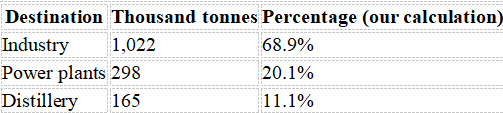
The text of the same balance gives different percentages: 63.5% for industrial use and 22.5% for electricity generation. We do not know the reason for the difference, so we show both figures.
What the balance shows is that bagasse in Ecuador already has recorded uses: it is not a residue without a destination.
According to the section of the US Environmental Protection Agency's AP-42 on bagasse combustion in sugar mills (1996), mills burn it in different types of boilers. The document gives these reference values:
Moisture. Most bagasse has between 45% and 55% moisture by weight as fired.
Heating value. Between 3,000 and 4,000 Btu per pound, on a wet basis: about 7.0 to 9.3 MJ/kg (our calculation).
Emissions. The most significant pollutant from bagasse-fired boilers is particulate matter.
The same document explains that, as the costs of fuel oil, gas and electricity rose, bagasse came to be regarded as a fuel rather than refuse.
What to plan for: a boiler designed for a fuel with that moisture, and particulate matter control. Why ash decides which burner works is explained in our Spanish-language article El problema de la ceniza.
Bagasse ash is not a single figure. In the studies we read:
· Ecuador. In bagasse from three artisanal sugar mills in Junín (Manabí), dried and ground, ash ranged from 1.94% to 4.47%.
· Brazil. In bagasse from a sugar mill in Campinas, ground, 2.5%.
· China. In bagasse from a sugar mill in Guangxi, 8.23%.
The US Environmental Protection Agency document gives a clue: improperly washed or incorrectly prepared cane can influence the ash content of the bagasse. That is why we recommend measuring the ash in your bagasse.
In pyrolysis, bagasse becomes biochar. Two recent studies measured it in laboratory fixed-bed reactors:
Brazil. With bagasse from Campinas (2.5% ash), the biochar yield was 33% at 400 °C, 28% at 500 °C and 25% at 600 °C. The ash in those biochars was predominantly above 3.4%.
Indonesia. With bagasse from a sugar mill in East Java, the non-activated biochar had 13.88% ash at 400 °C, 14.74% at 500 °C and 15.36% at 600 °C.
The two studies used the same temperatures, but different bagasse and reactors, and the Brazilian study does not give ash by temperature, so their figures cannot be compared directly. In these two studies, the ash in the biochar was very different. According to the European Biochar Certificate (EBC), the organic carbon in biochar ranges from less than 20% to 95% of dry matter, depending on the feedstock. The analysis of the biochar from your bagasse is what will tell you where it falls.
If you want the biochar certified under the EBC, the same rules apply as to any other, including: an H/Corg ratio below 0.7 in all its classes, and pyrolysis gases that are recovered or burned, not released into the atmosphere. The certificate class shows which use the biochar is admissible for. And if it is for farming in Ecuador, Agrocalidad requires registration to sell fertilisers, soil amendments and related agricultural products; check with Agrocalidad whether your product falls into that category. What to check before buying or selling biochar is covered in Biochar in Ecuador: what it is, what it is used for and how to tell whether it is good quality.
These questions apply to any equipment or service supplier, us included:
· How many tonnes of bagasse come out each month, and how much does my boiler already use?
· At what moisture does the bagasse leave the mill?
· Do I have an ash analysis of my bagasse?
· If I burn it: how does the boiler control particulate matter?
· If I pyrolyse it: at what moisture must it enter the reactor? What ash and what carbon will the biochar have? What happens to the gases?
· What energy do I lose in the boiler if I divert bagasse to pyrolysis, and how do I replace it?
· Who buys the biochar, and for what use?
In Ecuador, sugarcane bagasse already has a use, mainly in industry and electricity generation. Pyrolysing it is possible, but in the studies we read the ash in the biochar was very different between studies. Before deciding, we recommend measuring the moisture and ash of your bagasse, and working out what energy you would no longer have in the boiler.
Ecuador data:
· Ministerio de Energía y Minas, Balance Energético Nacional 2023, 1st edition, August 2024: §1.1.12 (p. 46) and §2.1.5, Table 2.13 (p. 60). PDF (accessed 10 Nov 2026)
References and studies:
· U.S. Environmental Protection Agency (1996). AP-42, §1.8: Bagasse Combustion in Sugar Mills. PDF (accessed 10 Nov 2026)· Cabrera Román, A. D., Velásquez Zambrano, M. E. and Muñoz Murillo, J. P. (2024). Characterization of the physicochemical, bromatological properties, and antioxidant activity of powdered sugarcane bagasse. Revista de la Facultad de Agronomía (LUZ) 41(2): e244114. doi:10.47280/RevFacAgron(LUZ).v41.n2.04. PDF (accessed 10 Nov 2026)· Fernandes, M. C., Nascimento, É. V., Valença, G. P. and Franco, T. T. (2026). Generation of Solid and Liquid Biofuels by Pyrolysis of Sugarcane Bagasse. Chemical Engineering Transactions 125: 109–114. doi:10.3303/CET26125019. PDF (accessed 10 Nov 2026)· Cao, W., Jing, H., Araya, D. T. and Zhao, W. (2026). Optimization of microwave-assisted pyrolysis parameters for sugarcane bagasse biochar using response surface methodology. doi:10.48130/scm-0025-0014. PDF (accessed 10 Nov 2026)· Sunyoto, N. M. S. et al. (2026). Effect of H2SO4 solution concentration and pyrolysis temperature on the characteristics of activated micro biochar from sugarcane bagasse waste. IOP Conference Series: Earth and Environmental Science 1617: 012017. doi:10.1088/1755-1315/1617/1/012017. PDF (accessed 10 Nov 2026)
Standards:
· European Biochar Certificate (EBC), v10.5E, 14 Aug 2025 — ch. 3, §7.1, §7.2 and §8.3. PDF (accessed 21 Oct 2026)· Agrocalidad, Manual técnico para el registro y control de fertilizantes, enmiendas de suelo y productos afines de uso agrícola, edition 7 (approved 13 Jun 2022); current validity not confirmed — §5.1. PDF (accessed 21 Oct 2026)
Methodology: every figure comes from the original text of the source, except the calculations marked as ours. The biochar studies are laboratory-scale and from other countries; their figures are not predictions for your bagasse. This article does not report data on Nina Energy's biochar or equipment.