
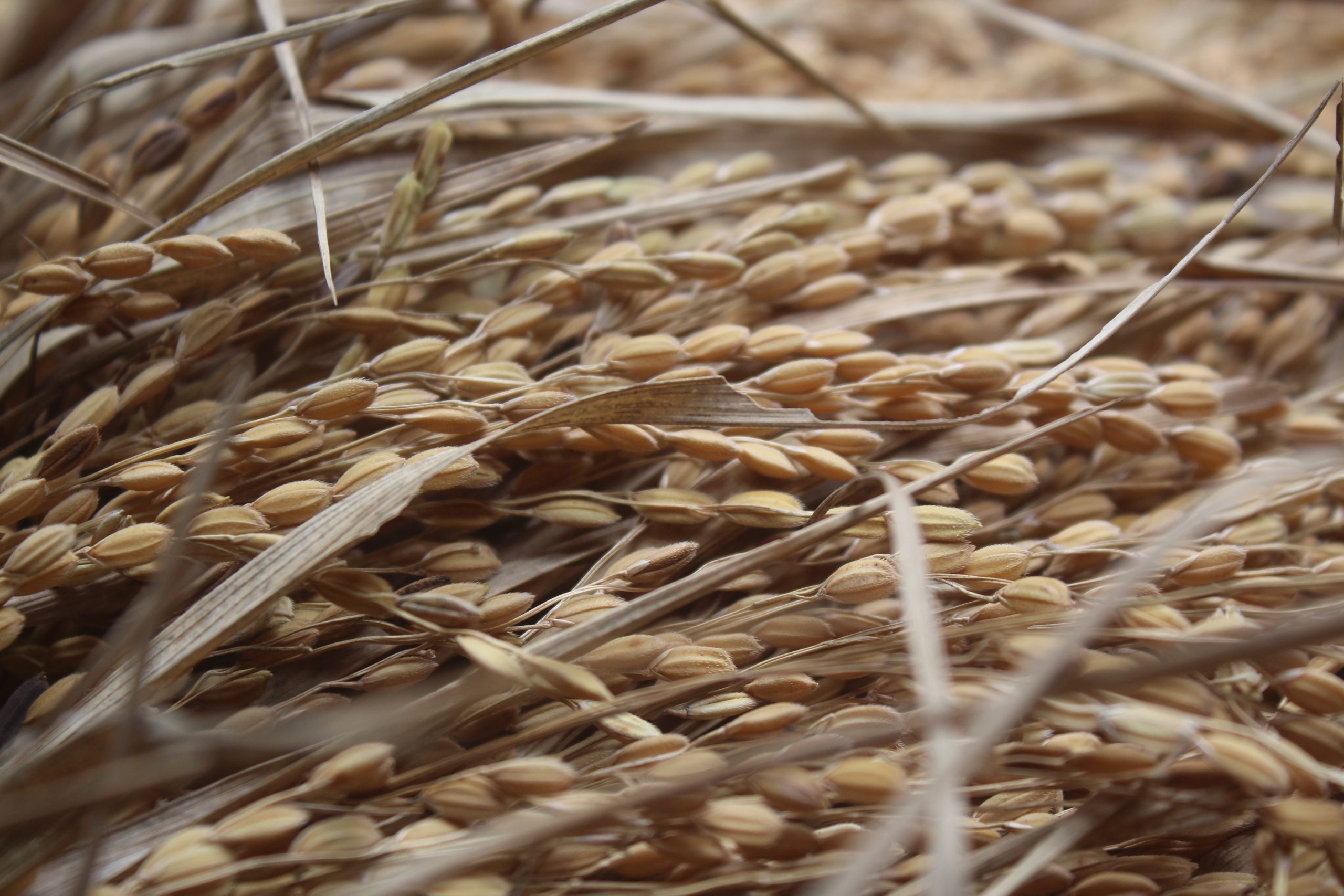
All three options are possible, but each one requires something different. Burning it gives heat, and leaves 15% to 25% of its dry weight as ash, almost all of it silica, which has to be handled. To compost it, plan for a nitrogen source: with one study's figures, the husk had about 62 parts carbon for every part nitrogen (our calculation). Pyrolysing it gives biochar: in a laboratory study, that biochar had 39% to 45% total carbon and a lot of ash, less carbon than wood biochar. The decision depends on what you need: heat, compost or a product to sell.
Contents
How much rice husk there is in Ecuador
In 2023, Ecuador produced 1.55 million tonnes of paddy rice, according to the Ministry of Agriculture and Livestock's bulletin based on INEC data. Around 95% came from Guayas and Los Ríos.
We did not find an official source stating how many tonnes of husk that harvest yields, so we do not give that figure. If you run a rice mill, what counts is your own volume: how many tonnes come out each month and what you do with them today.
Burning it for heat
Rice husk burns. A study of six varieties measured a lower heating value of 13.24 to 16.20 MJ/kg on a dry basis. The same study measured 15.30% to 24.60% ash on a dry basis, and 90% to 97% of that ash was silica. It also found that the chemical properties vary significantly from one variety to another.
With those figures, every dry tonne burned leaves 153 to 246 kg of ash (our calculation). Before buying a burner or boiler for rice husk, ask how it removes that ash and what happens to it afterwards. Why ash decides which burner works is explained in our Spanish-language article El problema de la ceniza.
Composting it
In a composting study published in 2015, the husk had 48.1% carbon and 0.78% nitrogen: a ratio of about 62 parts carbon to one part nitrogen (our calculation from those two figures). To compost it, the authors brought that ratio down to 30:1 by adding urea, and the process lasted 60 days.
If you are going to compost rice husk, plan where the nitrogen will come from and have room for composting that lasts about two months, as in the study.
Pyrolysing it
In pyrolysis, rice husk becomes biochar. In a laboratory study that pyrolysed it at 400 to 800 °C, rice husk biochar had 38.81% to 45.15% carbon. The authors found high ash across the whole temperature range, and linked it to the silicon in the rice plant.
For comparison: according to the European Biochar Certificate (EBC), wood and nutshell biochar is usually 70% to 90% organic carbon in dry matter. The laboratory study measured total carbon, not organic carbon; even so, its highest value, 45.15%, falls below that range.
If you want the biochar certified under the EBC, the same rules apply as to any other: the EBC requires an H/Corg ratio below 0.7 in all its classes, and requires pyrolysis gases to be recovered or burned: they must not escape into the atmosphere. The certificate class shows which use the biochar is admissible for. And if it is for farming in Ecuador, Agrocalidad requires registration to sell fertilisers, soil amendments and related products; check with Agrocalidad whether your product falls into that category. What to check before buying or selling biochar is covered in Biochar in Ecuador: what it is, what it is used for and how to tell whether it is good quality.
Questions before you decide
These questions apply to any equipment or service supplier, us included:
· How many tonnes of rice husk come out each month, and at what moisture?
· Which rice variety is milled? Husk properties vary with the variety
· Do I need heat at the plant? How much, and for which process?
· If I burn it: how does the equipment remove the ash, and what do I do with it?
· If I compost it: where will the nitrogen come from, and do I have room for two-month piles?
· If I pyrolyse it: what happens to the gases? Who buys the biochar, and for what use? Which batch analysis is it sold with?
· Can you show me an analysis of my own rice husk, not of a rice husk from the literature?
Frequently asked questions
Why does rice husk leave so much ash?
In the study we cite, ash was 15.30% to 24.60% of the dry husk, and 90% to 97% of that ash was silica. Another study links the ash of rice biochar to the silicon in the plant.
Is rice husk biochar the same as wood biochar?
No. In the laboratory study we cite, pyrolysed at 400 to 800 °C, it had 38.81% to 45.15% total carbon. According to the EBC, wood biochar is usually 70% to 90% organic carbon in dry matter.
Can rice husk be composted on its own?
In the 2015 study we cite, the authors did not compost it on its own: they added urea to bring the carbon-to-nitrogen ratio to 30:1. With their figures, the husk was around 62:1 (our calculation).
Which of the three is best?
It depends on your plant. If what you need is heat, the route is burning it. If you have a nitrogen source nearby, composting is an option. If you want a product to sell, pyrolysis gives biochar, and certifying it carries the requirements of any biochar. Get an analysis of your own husk before deciding.
Conclusion
Rice husk does not have a single answer. It has three routes, and each one asks for something: handling ash, planning for nitrogen or meeting what a certified biochar requires. Start by measuring your own husk and deciding what you need from it.
Sources and methodology
Ecuador data:
Ministerio de Agricultura y Ganadería (MAG), Boletín situacional arroz 2023, based on INEC-ESPAC 2023 data; figures updated to June 2024. PDF (accessed 22 Oct 2026)
Studies:
"Physical and thermochemical properties of rice husk". Energy Sources 19(9). Abstract at OSTI 562296 (accessed 22 Oct 2026)Wu, G., Qu, P., Sun, E., Chang, Z., Xu, Y. and Huang, H. (2015). Physical, chemical, and rheological properties of rice husks treated by composting process. BioResources 10(1): 227–239. PDF (accessed 22 Oct 2026)Jindo, K., Mizumoto, H., Sawada, Y., Sanchez-Monedero, M. A. and Sonoki, T. (2014). Physical and chemical characterization of biochars derived from different agricultural residues. Biogeosciences 11: 6613–6621. doi:10.5194/bg-11-6613-2014 (accessed 22 Oct 2026)
Standards:
European Biochar Certificate (EBC), v10.5E, 14 Aug 2025 — ch. 3, §7.1, §7.2 and §8.3. PDF (accessed 21 Oct 2026)Agrocalidad, Manual técnico para el registro y control de fertilizantes, enmiendas de suelo y productos afines de uso agrícola, edition 7 (approved 13 Jun 2022); current validity not confirmed — §5.1. PDF (accessed 21 Oct 2026)
Methodology: every figure comes from the original text of the source. The 62-to-1 carbon-to-nitrogen ratio and the kilograms of ash per tonne are our own calculations from the sources' figures. This article does not report data on Nina Energy's biochar or equipment.


