

Between 2018 and 2021, six biomass burners were installed at five coffee and cocoa farmer organisations in the northern Amazon and Manabí, replacing diesel or gas burners. With biomass, mostly palm kernel shell, the hourly cost of drying fell by a factor of 5 to 8, according to a 2022 technical report written by the person who is now Nina Energy's Chief Scientific Officer, about burners made by BDA, Nina's predecessor company. That calculation uses diesel at 1.90 dollars per gallon and does not include labour. Since September 2025 diesel in Ecuador is no longer subsidised, and since 12 October 2026 a gallon of Premium diesel costs 3.11 dollars at the pump.
Between 2018 and 2021, six biomass heating systems were installed at five coffee and cocoa farmer organisations in Sucumbíos, Napo, Orellana and Manabí. Four use palm kernel shell as fuel; the fifth uses a mix of palm kernel shell and coffee husk.
Disclosure: the data in this article come from a 2022 technical report for the Comité Europeo para la Formación y la Agricultura (CEFA). Its author, Mario Heredia, is now Chief Scientific Officer (CSO) of Nina Energy, and the burners were made by BDA (Bioenergía de los Andes), the predecessor company of Nina's technical team. The report is grey literature, not a peer-reviewed article. And these are burners that burn biomass to produce heat: they are not Nina Energy's pyrolysis reactor, and their figures do not apply to it.
How they were installed, according to the report:
· The biomass burner was fitted to the dryer using the same heat exchanger and combustion chamber as the diesel burner. A diesel burner can still be fitted as a backup.
· Its output is 120 thermal kilowatts, equivalent to the diesel burner it replaced. Those diesel burners used between 3 and 6 gallons per hour, according to their nameplates.
· According to the operators, after the switch the air entering the dryer keeps its temperature.
· With a full hopper, the burner runs for roughly 8 to 12 hours straight.
The report calculated the hourly cost of drying at each organisation, before and after the switch. It includes the fuel, the dryer's fan and, where there was one, the electricity generator. It does not include the operator's labour.
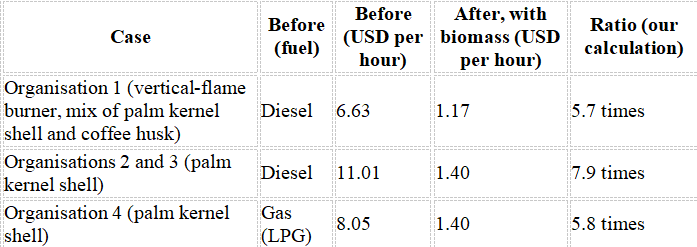
The author concludes that the technology reduced drying costs by a factor of 5 to 8. Put another way, drying came to cost between one fifth and one eighth as much. In its conclusions, the report gives an average saving of between 5.5 and 9.6 dollars per hour of dryer operation.
The basis for those figures, per hour and per unit:
· Diesel burner: 5.70 dollars (3 gallons per hour at 1.90 dollars).
· Biomass burner: 1.08 dollars (27 kilos per hour of palm kernel shell at 0.04 dollars a kilo, delivered to the organisation, transport included).
By the date of the report, the six installations had logged 4,052.3 hours of operation and 32,007.2 dollars of fuel savings.
What the equipment costs, and how long it takes to pay back, is explained in our Spanish-language article ¿Cuánto cuesta un generador de energía térmica a biomasa?.
The whole calculation in the report uses diesel at 1.90 dollars per gallon, and the author himself warns that the price had been rising. On 12 September 2025, the end of the diesel subsidy was decreed (Executive Decree 126): according to the press, a gallon for the automotive sector went from 1.80 to 2.80 dollars. Between 12 October and 11 November 2026, a gallon of Premium diesel costs 3.11 dollars. These are pump prices: check what your plant actually pays.
At that price, a diesel burner using 3 gallons per hour would spend 9.33 dollars per hour on fuel alone (our calculation), compared with 5.70 in the report. We do not know what palm kernel shell delivered to a plant costs today, so we do not recalculate the ratio at 2026 prices. For your case, ask for the current price of biomass delivered to your collection centre and run the numbers with your actual diesel use.
The report compares three burner versions. Its conclusion is that the fixed-bed, horizontal-flame burner had the highest efficiency and reliability. With palm kernel shell, in a BDA test, that burner measured 365 mg/Nm³ of carbon monoxide, corrected to 11% oxygen, against the European reference limit of 500 mg/Nm³, with a combustion efficiency of 99.8%.
In the same report, coffee husk pellets burned on their own, in a vertical-flame burner, gave 91,412.5 mg/Nm³ of carbon monoxide; we cover this in Cocoa pod husk and coffee husk: from waste to resource. The manufacturer's manual takes as reference a biomass with 15% moisture on a dry basis. Why ash decides which burner works is explained in our Spanish-language article El problema de la ceniza.
· Labour. The report's hourly cost excludes the dryer operator.
· Maintenance. The report's hourly costs are calculated from fuel, the fan and the generator; maintenance does not appear as a cost item. The report sets preventive maintenance every 250 hours of operation or every 3 months, whichever comes first. It warns that, without that service, the technology loses reliability and effectiveness.
· Biomass supply. The calculation uses palm kernel shell at 0.04 dollars a kilo, delivered to the organisation. With other biomass or another price, the numbers are different.
· How many gallons of diesel does my burner use per hour, according to its nameplate and according to my invoices?
· How many hours a month does my dryer run?
· What biomass do I have nearby, at what price delivered to my plant, and at what moisture?
· Does the new burner use my heat exchanger and combustion chamber, or do they need replacing?
· Can I keep the diesel burner as a backup?
· What carbon monoxide emissions did you measure with the biomass I am going to use, and under what conditions?
· How often does it need maintenance, what does it cost, and who does it?
In the documented case, drying coffee and cocoa with biomass, mostly palm kernel shell, cost between one fifth and one eighth as much as with diesel or gas, at prices from the date of the report (2022). Diesel costs more today, but the current cost of biomass is needed to know how much the ratio has changed. Before deciding, we recommend running the numbers with your own diesel use, the price of your biomass and the cost of maintenance.
Technical report:
· Heredia, M. A. (2022). Sistematización: resultados e impactos del uso de generadores de calor que utilizan biomasa residual. Technical report for the Comité Europeo para la Formación y la Agricultura (CEFA), Quito, 12 Jun 2022. Grey literature; the author is Chief Scientific Officer (CSO) of Nina Energy, and the burners are by BDA, Nina's technical predecessor. Pp. 4, 8, 10, 26–27, 31–34 and 48–50. (Not published online; read on 30 Oct 2026)
Diesel price:
· Primicias (13 Sep 2025). Nuevo precio del diésel tras la eliminación del subsidio. Article (accessed 30 Oct 2026)· Primicias (11 Oct 2026). Precio de las gasolinas en Ecuador: estos son los valores desde el 12 de octubre de 2026. Article (accessed 30 Oct 2026)
Methodology: every figure comes from the original text of the source, except the calculations marked as ours. The hourly costs are from four organisations, and the total saving from six installations at five organisations, at prices from the date of the report; they are not a prediction for your dryer. The organisations' names are in the report and we omit them here. This article does not report data on Nina Energy's pyrolysis reactor.


