
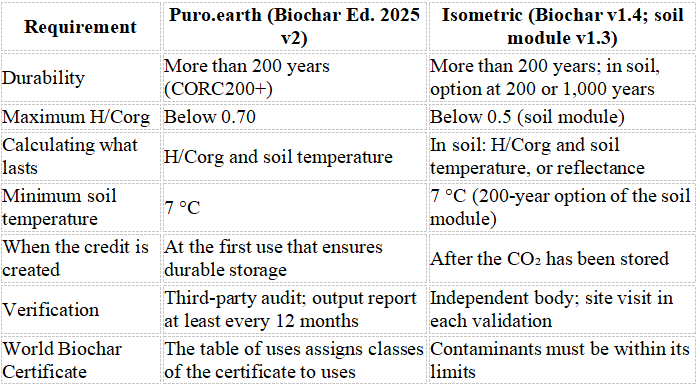
Puro.earth and Isometric are two of the standards that issue carbon removal credits for biochar. Both require the carbon to be stored for more than 200 years, the removal to be calculated as a net figure (subtracting the project's emissions), and an independent third party to audit the plant. They differ on details that matter: Puro accepts biochar with an H/Corg ratio below 0.70, while Isometric's soil module asks for less than 0.5. For biochar applied to soil, Isometric also has a second option at 1,000 years, based on reflectance measurements. This article summarises the methodologies in force on 4 November 2026.
A biochar carbon removal credit certifies that an amount of CO₂ was taken out of the atmosphere and durably stored in biochar. At Puro.earth, each credit is called a CORC and represents the durable net removal of 1 tonne of CO₂ equivalent.
The key word is "net". Puro calculates credits as follows: carbon stored in the biochar, minus the removal that would have happened without the project (baseline), minus carbon losses, minus project emissions, minus leakage. It also states that avoided emissions are never included. Isometric follows the same logic: carbon stored, minus the no-project scenario, minus emissions from establishment, operations, end of life and leakage.
At Puro, the value of a credit is realised when it is retired, which takes it out of circulation.
The version in force is Biochar Edition 2025, version 2, approved on 27 November 2025, together with the Puro Standard General Rules, version 4.4, from May 2026. The main points:
· Durability. Puro raised the durability of biochar to several centuries, more than 200 years, and its credits are called CORC200+. The previous edition issued CORC100+.
· Minimum biochar quality. It can be produced in any type of reactor, provided the biochar has a molar H/Corg ratio strictly below 0.70.
· How the lasting carbon is calculated. With a model that depends on the biochar's H/Corg and on the annual mean soil temperature in the region where it is used. It uses a minimum temperature of 7 °C and the lower bound of an 80% confidence interval.
· When the credit is created. At the first point in the supply chain where the biochar is used in a way that ensures durable storage. Puro has a table of uses: some earn credits, such as soil amendment, and others do not, such as pet feed or use as fuel.
· Methane. Residual methane emissions from carbonisation, expressed in CO₂ equivalent, must not exceed 15% of the carbon initially stored in the biochar.
· Additionality. The supplier must demonstrate three things: that there is more removal than in the baseline, that the activity is not required by law, and that the removal results from carbon finance.
· Audit. Before credits are issued, the plant undergoes a third-party audit, on site the first time unless the issuing body grants an exception. Then, at least every 12 months, it submits an output report that is reviewed by an independent auditor.
· Crediting period. 10 years, renewable twice with a new audit.
The protocol in force is Biochar Production and Storage, version 1.4. Isometric reviews it at least every 2 years. The main points:
· Durability. It requires CO₂ storage of more than 200 years.
· Where it is stored. There are three options, each with its own module: application to soil, burial in the shallow subsurface, and incorporation into building materials.
· Minimum quality in soil. The soil module (version 1.3) requires a molar H/Corg ratio below 0.5.
· How the lasting carbon in soil is calculated. There are two options, and each batch is certified under only one:
o At 200 years, with soil temperature and H/Corg. It uses a minimum of 7 °C, prohibits using air temperature instead, and applies a 95% cap.
o At 1,000 years, with random reflectance measurements (at least 500).
· Laboratory for soil. The soil module requires laboratories with ISO 17025 or equivalent.
· When the credit is issued. After the fact: once the CO₂ has been durably stored.
· Verification. An independent body validates and verifies, with a visit to the facilities at least once during each validation.
· Samples. The preferred option is to take at least 3 independent samples per production batch.
· Contaminants. They must be within the limits of the World Biochar Certificate.
· Pyrolysis gases. The protocol lists the permitted routes for those gases and requires evidence of emissions monitoring.
· Reactor emissions. Emissions tests at least once a year, or continuous measurement.
· Proof of soil application. Geotagged photos or videos with date and time, or plot maps with dates and quantities applied.
The World Biochar Certificate and the European Biochar Certificate (EBC) are trademarks of the same organisation, Carbon Standards International. What EBC certification is and what it measures is explained in Biochar in Ecuador: what it is, what it is used for and how to tell whether it is good quality.
Under these rules, we recommend that a biochar project that wants to sell credits has ready, at a minimum, how it will document:
· Where the biomass comes from, and why it is eligible.
· The H/Corg of each type of biochar, with samples per batch and laboratory analysis.
· What happens to the pyrolysis gases, and what emissions leave the reactor.
· Where the biochar goes and what use it ends up in, with evidence.
· Why the activity is additional.
· All of this, in a way an independent auditor can review, again and again.
These questions apply to any project developer or technology supplier, us included:
· Under which standard and which version of the methodology will the project be certified?
· Does the biochar meet the H/Corg that standard requires for the intended use?
· What use will the biochar end up in, and does that use earn credits under that standard?
· How will the end use be documented: invoices, geotagged photos, plot records?
· How are reactor emissions measured, and how often?
· Who does the laboratory analyses, and with what accreditation?
· How is additionality demonstrated?
· Who pays for the audits, and how often are they done?
Both standards ask for the same thing in broad terms: carbon that lasts more than 200 years, a net calculation and an independent auditor. The differences are in the details: the H/Corg threshold, how the lasting carbon is calculated and when the credit is created. Before designing a project, we recommend choosing the standard and reading its version in force, because both are updated.
Puro.earth:
· Puro.earth, Puro.earth Certification Framework — Biochar, Edition 2025, version 2 (approved 27 Nov 2025): glossary, §1, §2.2–2.3, §3.1, §3.3, §3.5, §3.6, §5 and §6.2. Methodology page (PDF read on 4 Nov 2026)· Puro.earth, Puro Standard General Rules, version 4.4 (approved 7 May 2026): 1.1.2, 2.3 and 2.4. Document library (PDF read on 4 Nov 2026)
Isometric:
· Isometric, Biochar Production and Storage, v1.4: §1.0, §3.0, §4.0, §5.2.1, §6.2, §8.1, §8.2, §8.3.2, §8.6 and §10. Protocol (accessed 4 Nov 2026)· Isometric, Biochar Storage in Soil Environments, v1.3: §3.1, Table 2, §5.1 and §8.5. Module (accessed 4 Nov 2026)
Methodology: this article summarises the versions of the methodologies in force on 4 Nov 2026; both are updated, so check the version in force before relying on them. It is not certification advice. This article describes third-party methodologies and does not report on Nina Energy's projects, registrations or credits.