

Less biomass than most people assume. Purpose-grown crops are excluded outright. Forestry residue has to come from a recognised certification scheme or an equivalent risk assessment, from an area whose forest carbon stocks are stable or rising, never from primary forest, and must not be material that could have become a long-lived wood product. Chain-of-custody documentation is mandatory, not a courtesy.
A biochar credit claims that carbon which would have returned to the atmosphere did not. Every part of that claim rests on what the biomass would otherwise have done. Residue left to decompose releases its carbon within a few years, so pyrolysing it removes something real. A tree grown specifically to be burned removes nothing that was not planted to be removed. A board that would have gone into furniture was already storing carbon, so pyrolysing it moves storage rather than adding it. This is why feedstock eligibility is not a sustainability footnote sitting beside the carbon maths — it determines whether there is any carbon maths to do.
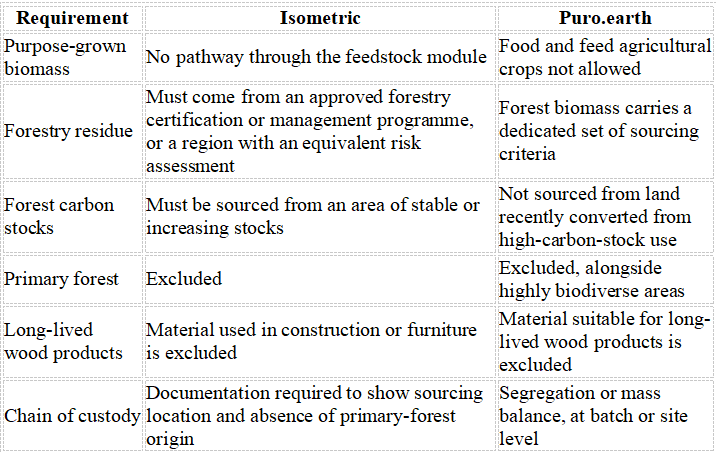
The two registries arrive at nearly the same place by different routes: Isometric delegates the detail to a separate feedstock accounting module, Puro.earth to a separate biomass sourcing criteria document. In both cases the rules live outside the headline methodology, which is why a supplier can cite a protocol version and still not have read the part that governs its own biomass.
Both registries now discount biomass that would have stayed out of the atmosphere on its own. Isometric treats the durably stored portion of the feedstock's counterfactual as ineligible for crediting. Puro.earth's sourcing criteria go further and ask projects to quantify how much biomass carbon would still be stored outside the atmosphere after fifteen years, with the requirement becoming mandatory for crediting periods starting on or after 1 January 2029, and applying to existing projects at renewal.
The practical effect is that slow-decomposing feedstock is worth fewer credits per tonne than fast-decomposing feedstock, even when the biochar is identical. A project modelled before these provisions came in may be carrying a volume assumption that no longer holds.
Feedstock is where a biochar project is easiest to check and easiest to get wrong. The rules are public, they sit in separate documents from the headline methodology, and they have tightened — the counterfactual-storage provisions are recent and change the volume a given biomass stream can support. For a buyer, the useful question is not whether a supplier uses residue. It is which category the residue falls into, which scheme certifies its origin, and what the project has assumed about what that biomass would have done if nobody had pyrolysed it.
Isometric, Biomass Feedstock Accounting Module v1.3 — https://registry.isometric.com/module/biomass-feedstock-accounting/1.3 (consulted 28 Sep 2026)Isometric, Biochar Production and Storage v1.3 — https://registry.isometric.com/protocol/biochar/1.3 (consulted 28 Sep 2026)Puro.earth, Biomass Sourcing Criteria v1.3, approved 3 Sep 2026 — https://puro.earth/cdr-infrastructure/methodologies/document-library/ (consulted 28 Sep 2026)Puro.earth, Certification Framework: Biochar, Edition 2025 V2, approved 27 Nov 2025 — same library (consulted 28 Sep 2026)European Biochar Certificate v10.5E — https://www.carbon-standards.com/docs/transfer/4000093EN.pdf (consulted 28 Sep 2026)FSC, Chain of Custody Certification FSC-STD-40-004 V3-1, published 2 Feb 2021, effective 1 Sep 2021 — https://by.fsc.org/sites/default/files/2021-09/FSC-STD-40-004_V3-1_EN_FINAL.pdf (consulted 28 Sep 2026)
Methodology: requirements were read from the protocol and standard documents themselves. The EBC positive list sits in an appendix that was not retrievable; no claim about any specific feedstock's EBC eligibility is made here.


