
Five things. The exact protocol and version a project is registered under, not the registry's name alone. Where the biomass comes from and how custody is documented. The molar H/Corg ratio and the laboratory that measured it. Whether credits are issued after the fact against third-party verification. And the durability horizon, together with the mechanism that produces it.
A supplier that says it is "registered with Isometric" has told you the shop, not the product. Isometric alone publishes several distinct protocols, and two of them sound close enough to be confused in a pitch deck: Biochar Production and Storage, which covers pyrolysis, and Subsurface Biomass Carbon Removal and Storage, which covers burying raw biomass below ground. They are different pathways with different quantification. The same holds across registries: Puro.earth, Verra and Rainbow Standard each credit biochar under their own methodology, on different durability horizons, by different mechanisms. The protocol name and its version number are the smallest unit of information that actually means something. Ask for both, then open the document.
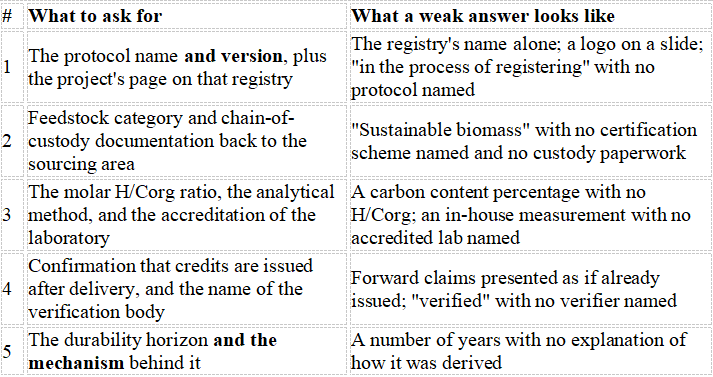
On check 3, the thresholds are not the same everywhere, which is why the number alone is not enough either. Isometric's soil storage module admits only biochar below 0.5. Puro.earth requires strictly below 0.70. Verra's VM0044 requires 0.7 or less for soil application. The European Biochar Certificate sets below 0.7 across its classes and tightens to below 0.4 for its strictest one. A producer quoting 0.6 is comfortably inside three of those and outside the fourth.
On check 5, the horizons are genuinely not comparable. Isometric applies a condition of storage longer than 200 years and lets a project quantify on either a 200-year or a 1,000-year basis. Puro.earth issues into a class it describes as at least 200 years. Verra works on a 100-year horizon and applies a permanence fraction that varies with pyrolysis temperature. Rainbow Standard requires at least 100 years and obliges projects to disclose whether they are claiming 100 or 1,000 years. Comparing two suppliers on years alone, without the mechanism, produces a false ranking.
None of these five checks requires specialist knowledge. They require a supplier willing to name documents rather than categories: this protocol, this version, this feedstock category, this laboratory, this verification body, this durability mechanism. A supplier that answers all five in writing has given you something you can audit. A supplier that answers in adjectives has given you a brochure. These are the questions Nina Energy expects to be asked, and the ones it asks of others.
· Isometric, Biochar Production and Storage v1.3 — https://registry.isometric.com/protocol/biochar/1.3 (consulted 28 Sep 2026). No publication date is displayed on the registry page; none is stated here.· Isometric, Subsurface Biomass Carbon Removal and Storage v1.2 — https://registry.isometric.com/protocol/subsurface-biomass/1.2 (consulted 28 Sep 2026)· Isometric, Biochar Storage in Soil Environments module v1.3 — https://registry.isometric.com/module/biochar-storage-soil-environments/1.3 (consulted 28 Sep 2026)· Puro.earth, Certification Framework: Biochar, Edition 2025 V2, approved 27 Nov 2025 — https://puro.earth/cdr-infrastructure/methodologies/document-library/ (consulted 28 Sep 2026)· Verra, VM0044 Biochar Utilization in Soil and Non-Soil Applications v1.2, effective 27 Jun 2025 — https://verra.org/methodologies/vm0044-biochar-utilization-in-soil-and-non-soil-applications-v1-2/ (consulted 28 Sep 2026)· Rainbow Standard, Biomass Carbon Removal and Storage (BiCRS) v1.1, 21 Jan 2026 — https://docs.rainbowstandard.io/methodologies/biomass-carbon-removal-and-storage-bicrs (consulted 28 Sep 2026)· European Biochar Certificate v10.5E — https://www.carbon-standards.com/docs/transfer/4000093EN.pdf (consulted 28 Sep 2026)
Methodology: every threshold and horizon above was read from the methodology documents themselves, not from secondary summaries. Where a document publishes no date, none is invented.


