
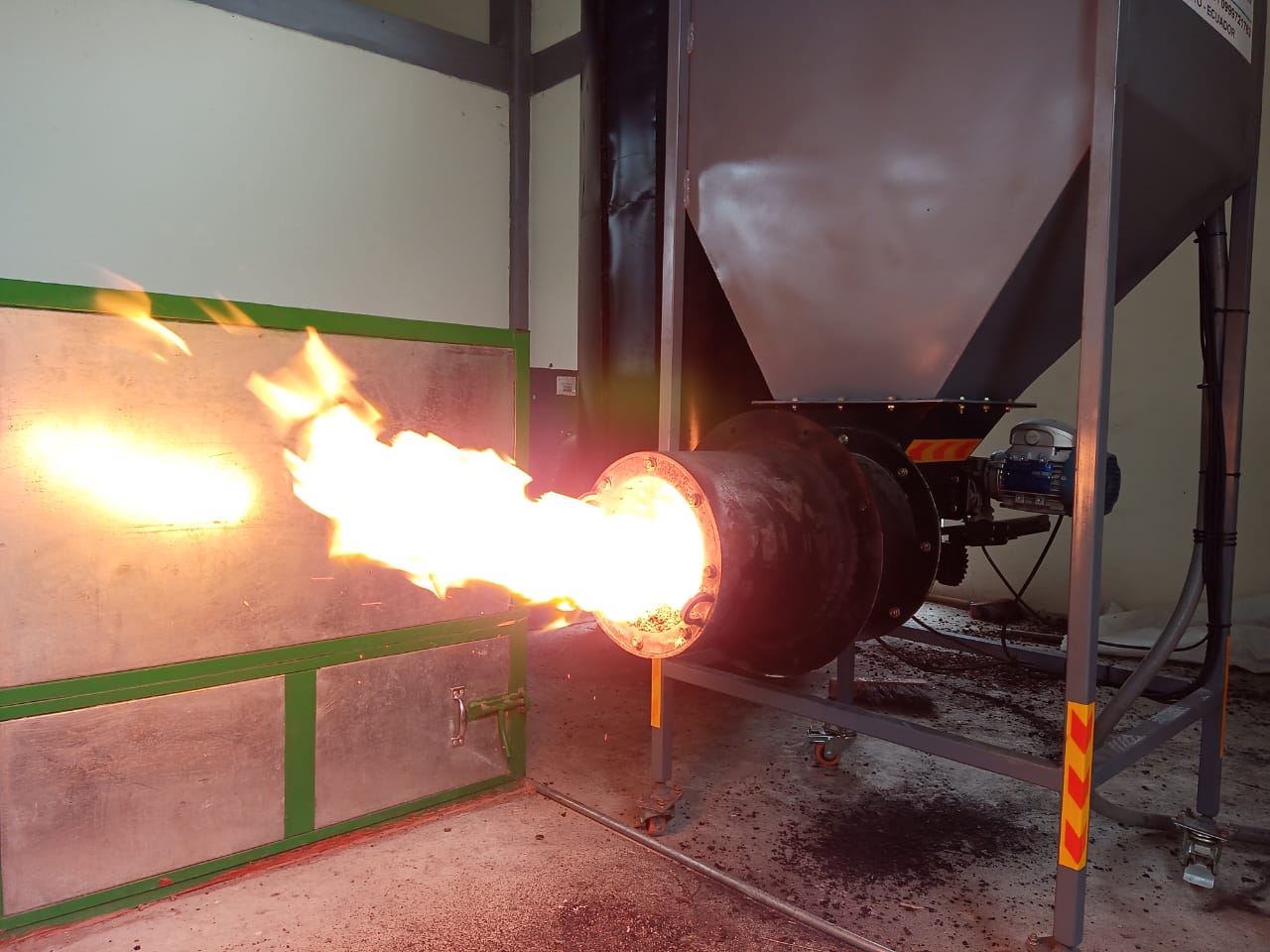
Making biochar also releases gas and vapours. The European Biochar Certificate (EBC) does not allow pyrolysis gases to be released into the atmosphere: they must be recovered or burned, and before release they must pass through a dedicated combustion chamber. According to the EBC, that gas carries approximately 35% to 60% of the energy in the biomass, and it is usually burned in the unit itself. In our reactor, the syngas is recirculated to the thermal system, and there is a flare for the excess. In our case, recovering bio-oil or wood vinegar is optional.
Contents
Four destinations for the gas
1. Syngas: the heat for the process Syngas is a combustible gas that includes carbon monoxide, hydrogen and methane. The EBC requires it to pass through a dedicated combustion chamber before release, that this combustion meets each country's emission limits and that excess heat is used, for example to dry biomass. It also prohibits fossil fuels for heating the reactor, except for preheating.
In our reactor, the syngas is recirculated to the thermal system, we dry the biomass with the flue gases and we start up on wood pellets or other biomass, without LPG.
2. Flare: the safety valve Our equipment has a flare for excess syngas. In the process industry in general, flares are primarily safety devices: they prevent the release of large quantities of unburned hydrocarbons. They are used in emergencies and also during start-ups and shutdowns, and they are the option when the heat of the gas cannot be recovered. A useful question for any supplier is when the flare runs, and for how long.
3. Bio-oil: a liquid that needs treatment Bio-oil is obtained by condensing the pyrolysis vapours. It has much more water and oxygen than heavy fuel oil, so its heating value is low, and its low pH corrodes equipment and storage tanks; it needs an upgrading treatment to improve its properties. The EBC counts it as useful energy and notes that it can be stored for later use. In our case, producing it is optional and not included in the equipment price.
4. Wood vinegar: mostly water Wood vinegar, or pyroligneous acid, comes from biomass pyrolysis alongside biochar. It is 80% to 90% water, and the rest is more than 200 organic compounds, such as acids, alcohols and phenols. Its composition depends on the pyrolysis conditions, above all the temperature. According to a 2022 study, in agriculture it is recognised as an antimicrobial agent, bio-insecticide and bio-herbicide; in that study it was applied diluted at ratios of 1:200 and 1:800, that is, one part vinegar to 200 or 800 parts water. Like bio-oil, in our case it is optional and not included in the equipment price.
A note on biochar quality: the EBC requires biochar and gas to be separated at temperatures that do not allow polycyclic aromatic hydrocarbons (PAH) to condense on the biochar.
Questions for any supplier
These questions apply to any offer, ours included:
· Where does the gas go: to a combustion chamber, to your process or to a flare?
· What is done with the heat from that combustion?
· When does the flare run, and for how long?
· Does the reactor use fossil fuel to heat up?
· If you want bio-oil or wood vinegar: is it included in the offer, and what treatment does it need before use?
Frequently asked questions
What is usually done with pyrolysis gas?
According to the EBC, it is usually burned in the unit itself. The oil and gas can also be captured for later use.
Does bio-oil work as a fuel?
It has much more water and oxygen than heavy fuel oil, so its heating value is low, and its low pH corrodes equipment and tanks. It needs an upgrading treatment to improve its properties.
Is wood vinegar applied undiluted?
In the 2022 study we cite, it was applied diluted at ratios of 1:200 and 1:800. Its composition changes with the pyrolysis temperature.
Conclusion
A pyrolysis reactor does not only produce biochar: it also produces gas, which according to the EBC carries approximately 35% to 60% of the energy in the biomass. If a supplier can tell you where that gas goes and when the flare runs, you know what you are buying.
Sources and methodology
Standards and guidance:
· European Biochar Certificate (EBC), v10.5E, 14 Aug 2025: §7.11, §8.1, §8.3, §8.4 and §8.5. PDF (accessed 14 Oct 2026)· US EPA, Air Pollution Control Technology Fact Sheet: Flare, EPA-452/F-03-019. PDF (accessed 14 Oct 2026)· US EPA, Air Pollution Control Cost Manual, Section 3.2, Chapter 1 "Flares", August 2019. PDF (accessed 14 Oct 2026)
Studies:
· Kumar & Panwar (2024). Clean Energy 8(4):61–78. doi:10.1093/ce/zkae036 (accessed 14 Oct 2026)· Ashoor et al. (2023). Bioresources and Bioprocessing 10:34. doi:10.1186/s40643-023-00654-3 (accessed 14 Oct 2026)· Jindo et al. (2022). Molecules 27(11):3397. doi:10.3390/molecules27113397 (accessed 14 Oct 2026)
Methodology: every statement about standards and studies comes from the source's original text, accessed 14 October 2026. The data on our reactor (syngas recirculation, flare, drying, start-up and the optional nature of the liquids) are Nina Energy's own operating data. This article reports no yields, emissions or results for Nina Energy's equipment or biochar.


