
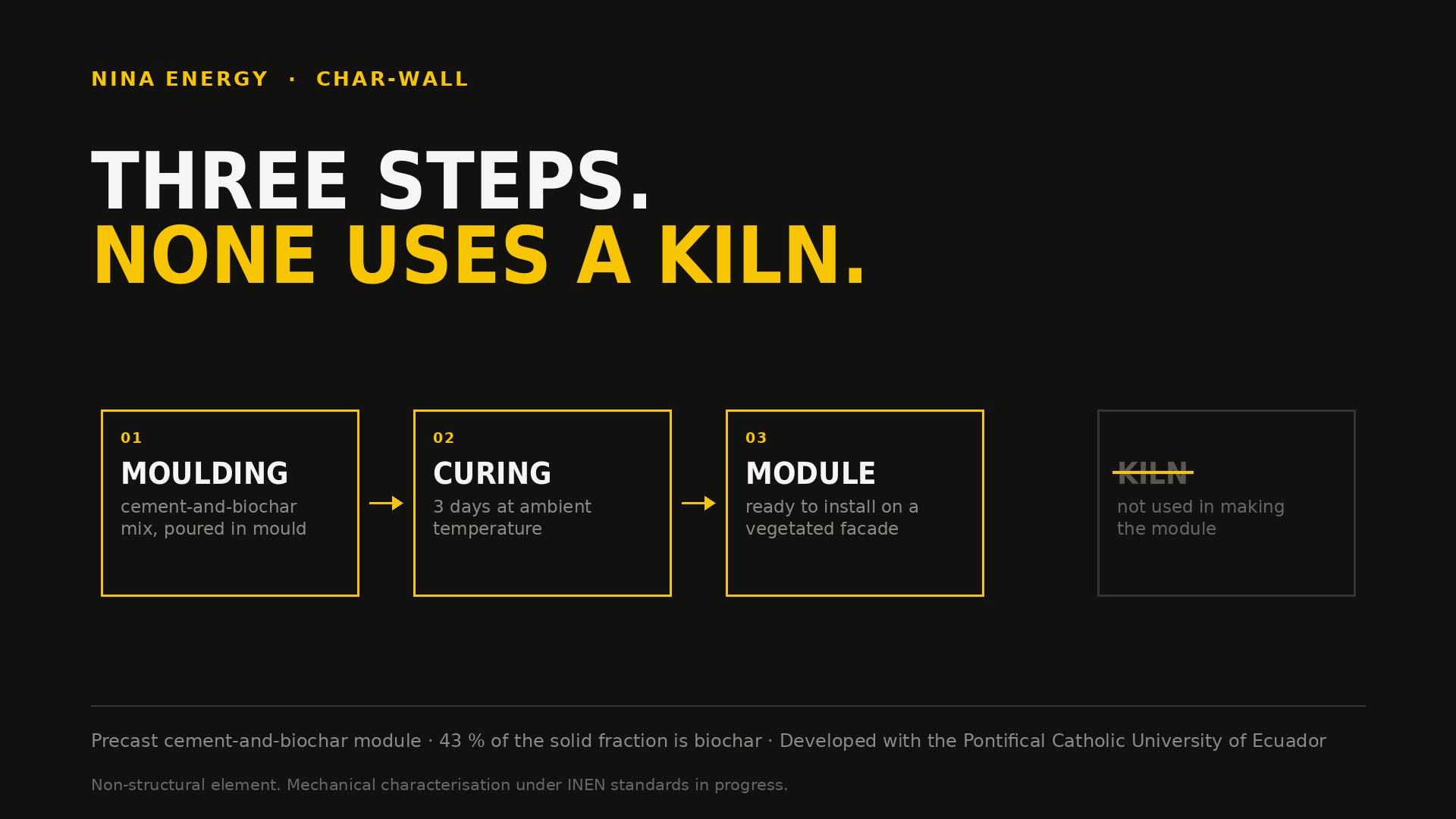
Char-Wall is a precast cement-and-biochar module for vegetated facades, developed with the Pontifical Catholic University of Ecuador. Biochar is 43% of its solid fraction — seventeen times the dose the published literature has studied for structural concrete. Char-Wall is not structural, and that dose sits far outside the range that evidence covers — it neither supports nor refutes it. Characterising it is the next step, and we say so before anyone asks.
Index
The dose ceiling, and where it stops applying
The best available evidence on biochar in cement is a meta-analysis of 606 paired observations by Zhao and colleagues (2024). On dosage it is unambiguous: below 2.5% of binder weight — binder meaning cement plus biochar — compressive strength rises 6% at 7 days and 7% at 28 days; higher dosages, the authors report, affected it negatively. We published that finding ourselves last week, including the part that does not flatter us.
Char-Wall carries 43% of its solid fraction. Those are two different denominators, and it matters: if the solid fraction includes aggregate, the equivalent dose on Zhao's basis is higher still. Seventeen times is a floor, not a figure.
What that paper can and cannot settle is worth being exact about. It measures compressive strength and nothing else — it says so itself, as a limitation: for lack of data it did not cover flexural strength or durability. That is not a licence to go higher. It means that at 43% the evidence is simply silent, and that the properties which actually govern a permanently irrigated vegetated facade — water absorption, porosity, durability — remain untested. Recent work suggests those properties constrain dose too: Kang and colleagues (2026) report a 31.1% increase in pore volume fraction at 7% biochar and propose 3–5% as the optimal range.
So the design thesis is a bet, and we call it that on purpose: a non-structural element lets us explore doses nobody has characterised, and that is where a quantity of biochar fits that structural concrete would never take. It is a technical hypothesis with a built product on top of it, not a published result. Which is exactly why the next milestone is testing rather than a campaign.
What the module is
A precast module that mounts on a facade and hosts vegetation. Cement and biochar, with biochar at 43% of the solid fraction. Developed with the Pontifical Catholic University of Ecuador. It is a finalist in the Sustainable Product shortlist of the 2026 Premios Br, in a category sponsored by the Consejo Ecuatoriano de Edificación Sustentable (CEES) and AB Arquitectura, per the organisers.
It is moulded and cured at ambient temperature in three days. No kiln. A comparable ceramic facade element is fired; Char-Wall consumes no thermal energy at the forming stage. The heat was spent earlier, in the pyrolysis that made the biochar. In an autothermal design such as the TTD reactor that energy comes from partially oxidising the pyrolysis products inside the reactor rather than from an external fuel; conventional pyrolysis does need outside heat.
For a carbon buyer the interesting part is not the facade. It is the destination. Biochar's usual home is agricultural soil: a low-price, seasonal market, and a dispersed one. Char-Wall puts that carbon inside a building envelope, in a product priced per square metre rather than per tonne. How much carbon ends up stored per square metre needs analysis of the biochar used, a mass balance of the module and third-party verification. That work is pending and we publish no figure until it is done.
What it does not have yet
No mechanical characterisation under INEN standards (Servicio Ecuatoriano de Normalización, Ecuador's national standards body). Until it has that it is a non-structural element and must be specified as one. Compression and flexural testing is the next milestone.
No national standard has been identified for biochar-cement composites, and no equivalent international product standard either. Every formulation is characterised separately, and there is no certificate to ask a supplier for.
No published carbon storage figure per tonne. The number exists and is in technical review. It publishes when it is closed.
FAQ
Can it be load-bearing?
No. It is a non-structural envelope element and must be specified as such until mechanical characterisation under INEN standards exists. That testing is the project's next step, not a commercial promise.
Why does cold curing matter?
Firing is where a conventional facade element spends its energy. Char-Wall is moulded and cured at ambient temperature over three days, so the forming stage contributes no thermal energy at all to the material's footprint.
Does this count as carbon removal?
Not on its own, and not yet. Durable storage in a built element is a recognised direction, but the accounting — how much, over what horizon, verified by whom — has to come from a carbon methodology, not from a product description. We are not claiming credits for Char-Wall.
Conclusion
Char-Wall is a finalist, not a winner, and a non-structural element, not a structural one. Both of those are stated because both are true. What is also true is the composition and the process: 43% biochar by solid fraction, three days of ambient curing, no kiln, and a building envelope that carries biochar instead of a sack that holds it until someone buys it.
Sources and methodology:
same as the Spanish version.
Methodology: the Char-Wall figures here are composition and process, not performance. No mechanical test result and no carbon storage figure is published, because neither is closed. The structural-concrete dose figure comes from the cited meta-analysis and does not apply to a non-structural element.


