
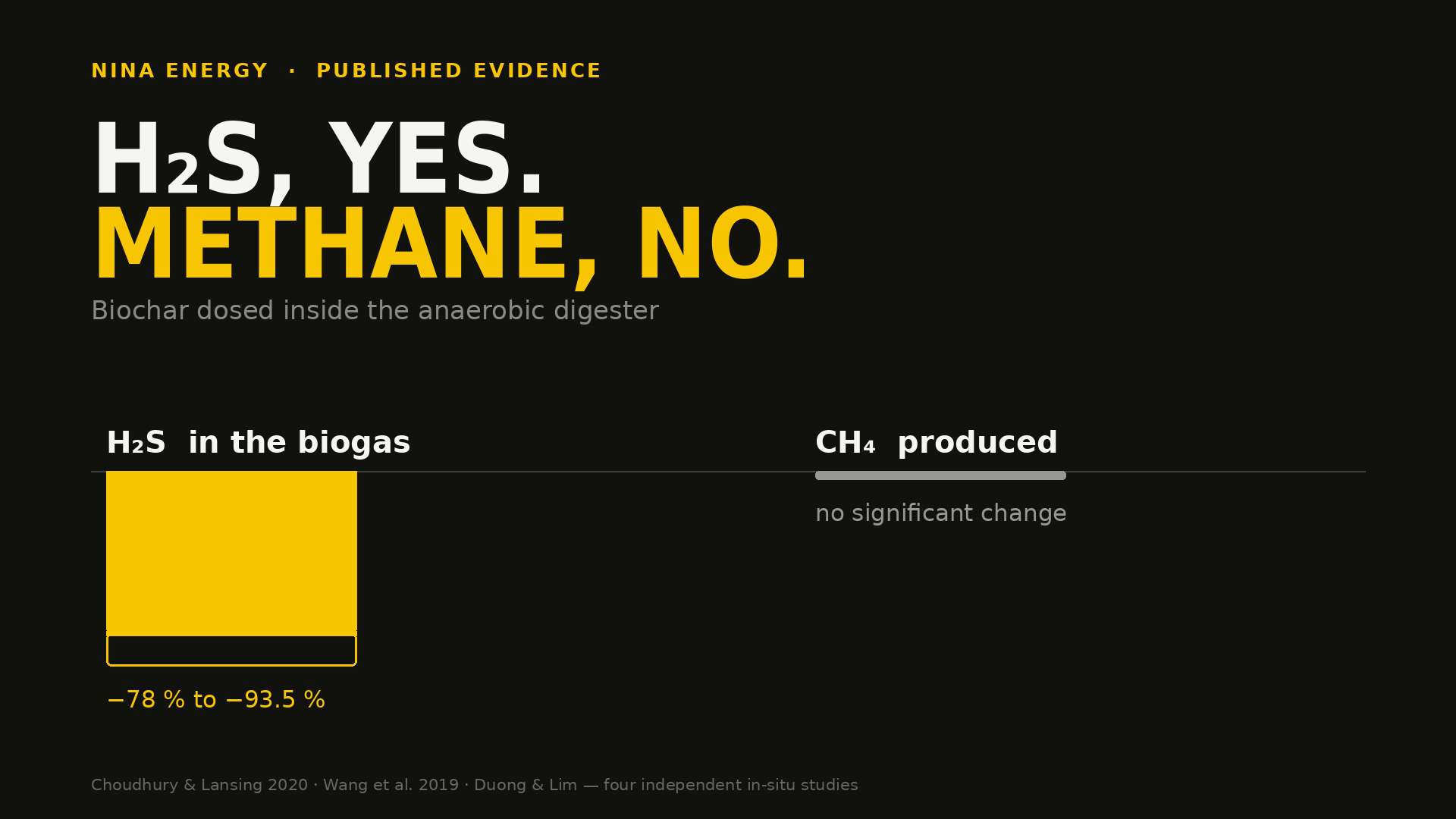
Two claims usually travel together, and only one survives scrutiny. Dosing biochar into a digester reduces hydrogen sulfide in the biogas, consistently and substantially. It does not reliably increase methane output in continuously operated systems. Anyone offering both from a single dose is ahead of the published evidence.
Index
The hydrogen sulfide result
This is the finding with the cleanest evidence behind it. Choudhury and Lansing (2020) dosed biochar into manure digesters and measured 90.5% less hydrogen sulfide than the control at 1.82 g biochar per gram of manure total solids; with iron-impregnated corn stover biochar at 0.5 g/g TS, no hydrogen sulfide was detected at all. Wang, Larson and Runge (2019) reported a 78% reduction per gram of total solids fed. Duong and Lim reported 93.5% in batch and 93.2% in the first week of semi-continuous operation. Different feedstocks, different laboratories, the same direction and a similar magnitude.
The practical caveat comes from that last study: effectiveness declined over time, and the authors suggest periodic resupply may be necessary. Biochar in a digester is a consumable, not a one-off installation.
The methane claim, and why it is weaker than it looks
The same four in-situ studies that found strong sulfide reduction found no significant methane gain. Choudhury and Lansing state it directly: "Methane (CH4) in the biochar and control treatments were not significantly different in all three experiments." Duong and Lim report that biochar "did not statistically alter biogas production in both systems."
This sits awkwardly beside two meta-analyses that report large positive effects — and the discrepancy is explained by what they cover. Chiappero, Fiore and Berruti (2022) pooled 408 experimental conditions from 76 studies in batch mode. Xiao and colleagues (2021) pooled 156 paired measurements from 27 publications. A batch bottle is not a running digester.
There is a second reason to be careful with those numbers. Both meta-analyses report standardized effect sizes, which are dimensionless and cannot be converted into a percentage. Neither of them reports a percentage, and Chiappero's stated reason for choosing a standardized metric is precisely that the underlying studies use different units of measure. A supplier quoting a percentage from these papers has produced it from somewhere other than the literature.
Individual studies are sober in both directions. Margreiter and colleagues (2024), testing gasification chars and activated carbons rather than biochar, found that doses below 1.0 g/L produced no significant effect at all, with positive and negative outcomes both observed above that. Vayena and colleagues (2024) tested seven biochars and found most had no impact; one 800 °C wood biochar reduced methane by 52% at 15 g/L, while a 400 °C biochar raised it 40% — which the authors attribute to residual biodegradable matter acting as an extra substrate rather than to any electron-transfer mechanism.
Dose, biochar type, and what goes wrong
There is no agreed optimal dose. Chiappero and colleagues report the largest effects at the lowest doses, below 5 g/L, with an economic ceiling around 0.45–0.76 g biochar per gram of volatile solids. A review by Devi and Eskicioglu reports 6–16 g/L as the range that performed consistently — a narrative synthesis rather than a pooled estimate. A 2026 review states plainly that there is no consensus. Those three positions cannot be reconciled into one number, so the honest answer is a range with its disagreement visible.
Biochar type matters more than dose. The properties associated with the best digestion performance — high ash, low carbon content, high oxygen-to-carbon ratio, acidic pH, low surface area — are close to the opposite of what a high-grade soil-amendment biochar looks like. Two meta-analyses disagree on whether surface area matters at all: one finds the largest effects below 10 m²/g, the other finds surface area is not a controlling factor.
Over-dosing is documented, not hypothetical. Negative methane results appear at 1% dose in one study and at 15 g/L in another, and a review describes excessive doses collapsing the microbial community's protective layer. More is not better.
Frequently asked questions
Will biochar increase my biogas yield?
On the current evidence, probably not in a running digester, and it may reduce it if you pick the wrong material or dose. The large positive results come from batch experiments; continuous and semi-continuous studies mostly show no change. If the business case for a project depends on extra methane, it needs a trial on that digester with that substrate before anyone commits to a number.
Is in-digester dosing the same as a biochar filter on the gas line?
No, and conflating them inflates the numbers badly. External adsorption columns report far higher capacities — one study measured 98% removal and up to 273 mg H₂S per gram of biochar, especially at 80–85% moisture. Another reported 3.3 to 6.1 mg/g for unmodified biochars, rising to 23.9 mg/g with iron impregnation. These are separate applications with separate evidence bases.
What biochar should be used?
Not necessarily a certified soil-amendment grade. The properties that suit digestion — higher ash, lower carbon, acidic pH — point toward a different material from the one sold for agriculture. Pyrolysis temperature appears to be the strongest single variable, with the same study reporting opposite signs for a 400 °C and an 800 °C biochar in the same digester.
Conclusion
The useful version of this technology is narrower than the pitch usually heard, and more defensible for it. Biochar dosed into an anaerobic digester is a credible route to reducing hydrogen sulfide, with consistent results across independent laboratories and a documented need for periodic resupply. It is not a reliable route to more methane. Separating those two claims is what allows a plant operator to evaluate the first one seriously.
Sources and methodology
· Choudhury, A. & Lansing, S. (2020). Bioresource Technology 306: 123121. DOI 10.1016/j.biortech.2020.123121 (consulted 30 Sep 2026)· Wang, Larson & Runge (2019). Bioresource Technology Reports 7: 100232. DOI 10.1016/j.biteb.2019.100232 (consulted 30 Sep 2026)· Duong & Lim. Case Studies in Chemical and Environmental Engineering 14: 101423. DOI 10.1016/j.cscee.2026.101423 (available online; consulted 30 Sep 2026)· Chiappero, Fiore & Berruti (2022). Journal of Environmental Chemical Engineering 10(6): 108870. DOI 10.1016/j.jece.2022.108870 (consulted 30 Sep 2026)· Xiao et al. (2021). Environmental Chemistry Letters 19(5): 3557–3564. DOI 10.1007/s10311-021-01251-6 (consulted 30 Sep 2026)· Margreiter et al. (2024) — gasification chars and activated carbons, not biochar. Heliyon 10(10): e31264. DOI 10.1016/j.heliyon.2024.e31264 (consulted 30 Sep 2026)· Vayena et al. (2024). Renewable Energy 237(A): 121569. DOI 10.1016/j.renene.2024.121569 (consulted 30 Sep 2026)· Devi & Eskicioglu (2024). Environmental Chemistry Letters 22(6): 2845–2886. DOI 10.1007/s10311-024-01766-8 (consulted 30 Sep 2026)· Kanjanarong et al. (2017). Bioresource Technology 234: 115–121. DOI 10.1016/j.biortech.2017.03.009 — and Choudhury & Lansing (2021), Journal of Environmental Chemical Engineering 9(1): 104837, DOI 10.1016/j.jece.2020.104837 (both consulted 30 Sep 2026)· Vuppaladadiyam et al. (2024). Reviews in Environmental Science and Bio/Technology 23(3): 699–737. DOI 10.1007/s11157-024-09700-8 (consulted 30 Sep 2026)
Methodology: in-situ dosing and downstream adsorption are reported separately throughout, because their figures are not comparable. Where two meta-analyses disagree, both positions are given rather than averaged. No figure from any study is applied to a specific digester or substrate.


